

A CEO or senior executive should consider starting a podcast when the show has a clear job, a specific audience, something useful to say, and a realistic plan for production and distribution.
A podcast should not exist simply because the CEO wants one.
That is usually how bad podcasts are born.
The best executive podcasts do something few other corporate formats can. They let people hear how a leader actually thinks. Not just the polished conclusion, but the judgment, tradeoffs, doubts, stories, questions and human details behind it.
A good executive podcast can help employees understand the people behind decisions affecting their work. It can help customers, partners, recruits and the public understand how a company thinks, not only what it sells. And it can give a leader a credible platform for contributing to an industry conversation over time.
The executive’s name might earn the first click.
It will not earn the second episode.
The podcast still has to be worth listening to.
If you are still deciding whether podcasting is the right medium at all, start with our broader guide: Should Your Company Start a Podcast? 7 Questions to Ask First.
What is an executive thought leadership podcast?
An executive thought leadership podcast is an audio or video series in which a CEO or senior leader uses their experience, expertise, access and curiosity to create useful content for a defined audience.
The executive might host interviews, be interviewed themselves, co-host with a journalist or subject-matter expert, or appear as a recurring voice within a broader editorial format.
“Thought leadership” is used pretty loosely.
A title does not make someone a thought leader. A microphone does not make something thought leadership.
The content has to help people understand a difficult subject, see a problem differently or make a better decision.
A CEO update is communication. A product announcement is marketing. Either may appear in a podcast, but neither automatically gives someone a reason to subscribe.
Thought leadership starts with audience value:
What can this executive contribute to the conversation that the audience genuinely needs or wants to hear?
Should your CEO start a podcast?
Probably, if the executive has something useful to explore, the organization can sustain the work, and the podcast supports a defined business or cultural objective.
Probably not if the project is mainly a vanity vehicle, a substitute for better internal communication, or a content campaign with no plan beyond launch.
Signs a CEO podcast makes sense
There is a real job to do. The show might build trust in a complicated category, explain how leadership makes decisions, strengthen employee connection or change a specific perception.
The audience is identifiable. You know whose attention matters and why those people might choose this particular show.
The executive has an advantage. That might be unusual access, hard-won experience, original research, a distinctive worldview or an ability to convene people others cannot.
There is an editorial engine. You can identify enough strong ideas to support an entire season without filling the schedule with random interviews.
The organization can support consistency. Someone owns strategy, preparation, recording, approvals, production, publishing, promotion and measurement.
And the leader is willing to sound human. They do not have to overshare. They do need enough curiosity, specificity and spontaneity to create an actual conversation.
Signs you should wait
Think twice if the real objective is simply making the CEO more visible.
The same applies if every answer requires enough approval to sand off all traces of opinion, the team cannot name 10 to 15 genuinely useful episode ideas, or the executive will not prepare, protect recording time or help promote the work.
And sometimes a podcast is simply the wrong tool.
A memo, town hall, keynote, webinar, article or guest appearance on someone else’s podcast might solve the problem faster.
What can an executive podcast accomplish?
A well-designed executive podcast can humanize leadership, make culture visible, build authority, strengthen internal alignment and create a repeatable source of useful content.
It cannot manufacture trust by itself.
The leader still has to be credible. The subject matter still has to matter. The production has to respect the audience’s time.
Humanize leadership without manufacturing vulnerability
Voice carries information a quote in a press release cannot.
Listeners hear pacing, humour, conviction, uncertainty, passion and the way someone responds when a conversation moves somewhere unexpected.
Humanizing an executive does not mean turning their private life into content.
It means making their thinking more visible.
The revealing moments are often small: the question they ask before an interview officially starts, the mistake that changed how they hire, the customer conversation they still remember or the decision that looked simple from the outside but was anything but.
Give employees context around decisions
For employees, one of the biggest benefits of an executive podcast is context.
People do not only want to know what leadership decided. They want to understand why, what alternatives were considered and what the decision means for their own work.
A recurring podcast gives leaders room to explain those things with more nuance than a short email or slide deck.
If employee alignment, change communication or leadership visibility is the main job, see JAR’s guide to internal podcasts.
Show the culture behind the company
For external audiences, an executive podcast can demonstrate how a company thinks.
The stories the leader chooses, the questions they ask, the guests they invite and even the disagreements they are willing to enter all communicate something about the culture.
Customers, partners, recruits and future employees may form an impression of the organization long before they reach a formal sales or hiring process.
Build authority through usefulness
Authority is earned through repeated usefulness.
A strong executive podcast can help people navigate complicated issues, bring credible people together and make expertise accessible without flattening it.
The goal is not to sound like the smartest person in the room.
It is to create one of the most useful conversations in the category.
Should an executive podcast be internal, public-facing or both?
Choose the audience before choosing the format.
An internal executive podcast is designed primarily for employees. A public-facing show is designed to earn attention outside the company. A hybrid podcast can serve both groups when their interests genuinely overlap.
Trying to serve everybody usually produces content nobody particularly needs.
| Model | Best for | The editorial test |
|---|---|---|
| Internal executive podcast | Alignment, culture, change, onboarding, leadership visibility | Would this help employees understand or do their work better? |
| Public executive podcast | Category authority, education, reputation, customer and partner trust | Would someone with no obligation to the company still choose to listen? |
| Hybrid executive podcast | Culture, leadership or expertise relevant inside and outside the organization | Can one clear editorial promise serve both audiences? |
Three executive podcast examples
lululemon: an internal podcast built around access
The lululemon Speakers Series Podcast case study shows what an internal podcast can do when it solves a real access problem.
The show was created to connect a fast-growing global workforce with the ideas, leaders and conversations happening at the company’s Vancouver headquarters.
Working with host Juma Wood, Senior Learning + Leadership Partner at lululemon, JAR created a recording environment at headquarters and turned local speaker events into an on-demand program employees could access anywhere.
Employees were encouraged to listen and given time during work to do so.
75% of employees chose to tune in, and the podcast achieved a 95% average consumption rate.
The useful lesson is not that every internal podcast needs famous speakers.
The show solved an access problem. Employees around the world could participate in cultural moments and conversations they otherwise would have missed.
D-Wave: executive expertise for an external audience
D-Wave’s Quantum Matters, hosted by VP of Quantum Technology Evangelism Murray Thom, turns a highly technical topic into practical conversations about where quantum computing is being used today.
Its central editorial question is simple:
Why should a business leader care about quantum computing now?
JAR’s Quantum Matters case study reports more than 23,000 unique listeners in the first half of season one, a number 21 ranking in Apple’s U.S. Technology category and steady audience growth without paid podcast advertising.
The company has plenty of expertise.
The podcast becomes useful because that expertise is organized around the audience’s questions rather than the company’s desire to explain its technology.
Amazon: a podcast serving employees and the public
Learn and Be Curious with Doug Herrington brings Amazon’s Leadership Principles to life through conversations between the CEO of Worldwide Amazon Stores and other Amazonians.
Instead of presenting those principles as slogans, the show explores how people use them in pharmacy, delivery, shopping and other real-world decisions. Listeners also hear how different Amazon leaders built their careers.
Employees get a deeper look at company culture and career paths.
External listeners get an inside view of how Amazon operates and makes decisions.
A hybrid approach works here because both audiences are interested in the same underlying subject: how Amazon’s culture works in practice.
What makes a good CEO or executive podcast?
A strong executive podcast needs more than a recognizable host.
It needs a clear job, a specific audience, a useful point of view, an appropriate format, strong preparation, good production, consistent publishing and a plan for earning attention.
The executive is part of the value proposition.
They cannot be the entire value proposition.
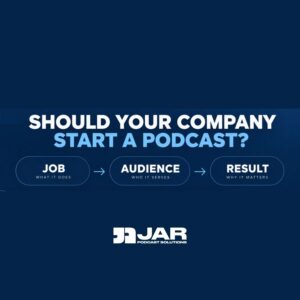
1. Start with the job, audience and result
Before microphones, guests or logos, define three things:
Job: What business, communication or cultural problem does the podcast need to address?
Audience: Whose attention matters?
Result: What evidence would tell you the show is working?
At JAR, this is the foundation of the J.A.R. System: Job. Audience. Result.
“Build thought leadership” is too vague.
“Help technology executives understand practical applications of quantum computing” is usable.
2. Make one clear promise
Someone should be able to understand why the podcast exists in one sentence.
That promise should describe the value to the audience, not the status of the host.
3. Choose a format that fits the executive
A naturally curious executive may be a strong interviewer.
A thoughtful but formal leader might work better alongside an experienced journalist or co-host.
A busy specialist may be more effective as a recurring contributor than as the sole host.
Design around the person you actually have, not the fantasy host everyone imagined in the planning meeting.
4. Prepare for insight, not recitation
Good preparation gives the host facts, story prompts, likely tensions and smart follow-up routes.
It does not script every answer.
Over-scripting removes the thinking and presence that made the executive worth hearing in the first place.
5. Use specific human detail
Ask what happened next.
Ask what surprised them.
Ask what changed their mind.
Ask what the room felt like when the decision was made.
Specific details make leadership stories believable and memorable.
6. Edit with judgment
Executive status should not protect weak material.
Remove throat-clearing, repeated talking points and sections that serve the company but not the listener.
Keep complexity when it helps.
Cut it when it does not.
7. Protect production quality
Audiences will forgive a modest studio.
They will not enjoy distracting audio, patchy lighting, confusing structure, unreliable remote connections or video that makes the host look unprepared.
Production quality communicates respect for the audience.
8. Publish consistently
Consistency does not mean weekly.
A useful monthly podcast is better than an ambitious weekly show that quietly vanishes after episode four.
Batching episodes and working in seasons can make much better use of an executive’s schedule.
9. Design distribution before launch
A LinkedIn launch post is not an audience-growth strategy.
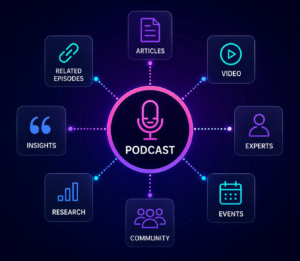
Use executive and guest networks, internal communications, newsletters, search-friendly episode pages, social video, articles, events and partnerships.
Every episode needs both a reason to be shared and a route through which it can travel.
10. Measure the job
Downloads are useful.
They are rarely the entire result.
Track the behaviours that correspond with the reason the podcast exists, such as completion, repeat listening, employee understanding, qualified conversations, newsletter subscriptions, search visibility, guest amplification or sales influence.
What should a CEO podcast talk about?
The best executive podcast topics sit where three things overlap:
What the audience is trying to understand.
What the executive genuinely knows or has experienced.
What the organization has credibility to discuss.
That can include difficult decisions and the tradeoffs behind them, things the leader has changed their mind about, operating principles behind company culture, industry questions customers are already asking, original research, career paths, lessons from failures or near misses, and stories from employees, customers, scientists, operators, partners or communities.
The show should reveal how the leader thinks while giving the listener something useful enough to learn from, apply or share.
A simple test for every episode idea
Before approving an episode, answer four questions:
What audience question does this address?
Why is this executive or guest qualified to explore it?
What will the listener know, feel or be able to do afterward?
Why might someone send this episode to one specific person?
If those answers are fuzzy, the episode probably is too.
What should an executive podcast avoid?
The most common executive podcast failure is not poor audio.
It is content designed around what the organization wants to say instead of what the audience wants to hear.
Watch for the vanity project, where executive visibility becomes the whole objective.
Watch for the company-news podcast, where every episode sounds like an announcement.
Watch for generic interviews with impressive guests but no editorial thesis.
Watch for approval processes that remove every interesting opinion.
Watch for the absentee host who repeatedly cancels and treats promotion as somebody else’s problem.
Watch for episodes that stay long because the guest is important rather than because the conversation is good.
And watch for the silent launch: publishing a show to podcast apps and assuming an audience will somehow materialize.
Podcast apps contain podcasts.
They do not contain magic.
How do you create an executive podcast?
A strong executive podcast process moves from strategy to editorial design, testing, production, distribution and measurement.
Do not begin with microphones.
If you want the complete strategy behind this approach, see the J.A.R. System.
Step 1: Define the job
Name the business, communication or cultural problem the show needs to address.
Be specific about the change you want it to support.
Step 2: Choose the audience
Identify the people you most need to reach and when the podcast would become useful to them.
Step 3: Define the result
Choose leading and lagging indicators before launch.
Decide what evidence will count and when you will review it.
Step 4: Research the audience
Talk to them.
Research the questions they ask, the content they already consume, the things they distrust and where audio or video fits into their lives.
Step 5: Find the show’s advantage
Identify the expertise, access, research, stories, community and executive perspective competitors cannot easily reproduce.
Step 6: Assess the host
Evaluate curiosity, clarity, listening skills, energy, availability and willingness to be coached.
Then decide whether the executive should host alone, co-host, be interviewed or contribute another way.
Step 7: Design the format
Choose the episode structure, length range, recurring segments, guest role, audio or video approach and season structure around the audience and host.
Step 8: Prove the editorial engine
Develop at least 15 specific episode ideas.
Group them into themes and make sure each one addresses a meaningful audience question.
If idea number seven already feels thin, pay attention.
Step 9: Test the show
Record before you launch publicly.
Evaluate the host, format, structure, pace, usefulness and production workflow.
Fix expensive problems while almost nobody is watching.
Step 10: Build the operating system
Establish roles, preparation deadlines, approval windows, recording blocks, backup episodes, editing timelines, publishing responsibilities and escalation rules.
Step 11: Build the growth plan
Map owned, earned, internal, executive, guest, social, search, newsletter and event distribution before episode one is released.
Step 12: Launch, learn and adjust
Review quantitative behaviour and qualitative feedback.
Change titles, openings, episode length, segments, guests or cadence when the evidence points toward a better experience.
How long does it take to launch an executive podcast?
A professionally developed executive podcast often takes roughly eight to twelve weeks from strategy to launch.
A simple, already-developed concept may move faster.
A show involving several executives, custom video, complex approvals, security review, original music or private distribution may take longer.
The point of the development period is not bureaucracy.
It is to solve expensive problems before they become public episodes.
How much time does the executive need to commit?
The executive should spend their time where their contribution cannot be replaced: shaping the point of view, preparing for important conversations, recording and participating in selective promotion.
A production team can handle research, scheduling, guest coordination, technical setup, editing, publishing, distribution and reporting.
Batch recording can help. So can predefined seasons and recurring recording windows protected months in advance.
But efficiency has limits.
Three video interviews in a row may look beautiful on a spreadsheet and considerably less beautiful on the executive by hour three.
What if the CEO is not a natural podcast host?
The CEO does not need to host alone.
First ask whether they actually want to participate.
Then test the format and give specific coaching.
A skilled interviewer, co-host, narrative producer or recurring executive segment can create a much better show than forcing someone into a traditional one-on-one interview format.
Hosting is also a craft.
Executives can improve at concise answers, listening, follow-up questions, storytelling and speaking without a script.
Coaching cannot fix a leader who does not want to prepare, listen or say anything beyond approved messages.
Design around reality.
Should an executive podcast be audio or video?
Choose audio, video or both based on the audience, host, subject and distribution strategy.
Audio is intimate, flexible and easy to consume while doing something else.
Video can expand discovery and create useful visual assets, but it adds complexity and can make some executives or guests more guarded.
Recording both can work well when the video experience is intentionally produced and the organization has a real plan for distributing it.
Do not add cameras simply because “we want a video podcast.”
Ask where your audience already spends time, whether visuals improve the subject, how comfortable the executive is on camera and whether you have the resources for editing, thumbnails, captions, clips and platform-specific publishing.
How often should an executive podcast publish?
Publish at the most frequent cadence the organization can sustain without weakening the content.
Weekly, biweekly, monthly and seasonal executive podcasts can all work.
Relevance and reliability matter more than volume.
A public show may benefit from enough frequency to build a listening habit. An internal show may align more naturally with leadership moments, onboarding cycles or organizational change.
Whatever cadence you choose, tell the audience what to expect.
Then keep the promise.
How do you make an internal executive podcast worth employees’ time?
Start with an employee need, not a leadership message.
An internal podcast should reduce uncertainty, strengthen connection, support development, improve understanding or make a large organization easier to navigate.
Interview employees from different levels and parts of the organization.
Show how people built careers, changed roles, found mentors or solved difficult problems.
Create credible conversations around pressures employees actually experience.
Invite questions, topic suggestions, voice notes and guest nominations.
Use intranets, newsletters, manager communications and team channels to make the show easy to find.
And if people are expected to consume it outside work, ask yourself a slightly uncomfortable question:
Would they choose to?
If not, either make the content better or give them space to listen during the workday.
How should an executive podcast be measured?
Measure the result the podcast was designed to create.
Audience metrics help diagnose performance. Business and cultural indicators tell you whether the show is actually doing its job.
For employee alignment, useful signals include reach, completion, repeat listening, survey feedback and manager observations.
For category authority, consider qualified audience growth, search visibility, citations, invitations and guest amplification.
For demand and relationships, look at newsletter subscriptions, site behaviour, qualified conversations and influenced opportunities.
For content efficiency, measure how successfully each conversation is reused across video, social, articles, newsletters, sales materials and internal channels.
Downloads matter.
They just cannot tell you everything.
Executive podcast checklist
Before approving an executive podcast, your team should be able to answer yes to most of these questions:
- Can we state the podcast’s job in one sentence?
- Can we describe the primary audience more precisely than “business leaders” or “employees”?
- Do we know why that audience would choose this show?
- Does the executive bring useful expertise, access or hard-won experience?
- Can we identify at least 15 strong episode ideas?
- Does the format fit the executive’s actual strengths and schedule?
- Will the executive accept coaching and editorial feedback?
- Are responsibilities and approval deadlines clear?
- Can we publish consistently for a full season?
- Is there a distribution plan beyond podcast apps?
- Have we defined success before launch?
- Would the concept still make sense if the CEO’s name disappeared from the title?
That last question has killed a few bad ideas. As it should.
The real question is not whether your CEO wants a podcast
It is whether the audience needs this one.
An executive can open doors, bring authority and make a podcast feel consequential.
None of that replaces a clear purpose or a strong editorial idea.
Start with the job.
Define the audience.
Decide what result matters.
Then build a show that helps people better understand the leader, the work, the culture or the category through conversations worth returning to.
JAR Podcast Solutions helps organizations define what a podcast needs to do, design it around the people it needs to reach, and build the production, distribution and measurement system around that goal.
If you’re considering an executive podcast, start the conversation.
We’ll tell you plainly whether a podcast is the right tool.