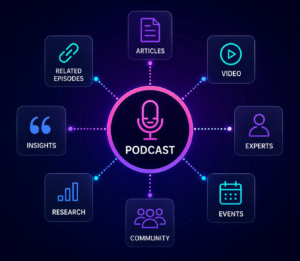


What happens when episodes, ideas, experts and audiences start adding value to each other over time?
A recurring podcast can become more valuable with every episode because it turns individual conversations into a connected, attributable body of expertise.
The first episode creates something useful.
The 30th episode can make the first 29 more useful too.
That is a very different way of thinking about podcast value.
I recently read Anne Beaulieu’s newsletter piece, When the Internet Outgrew the Engagement Model, and it sent me down a rabbit hole.
Beaulieu works in an emerging area she calls Authority Infrastructure. She is interested in how expertise remains recognizable, traceable and attributable as AI systems increasingly interpret, summarize and redistribute information before people encounter it.
Her argument, as I understand it, is that experts aren’t necessarily losing depth.
They’re losing attribution.
Ideas can travel remarkably far while becoming separated from the people, organizations and larger bodies of knowledge they came from. Expertise can continue to deepen without becoming any easier to recognize as part of a coherent whole.
She puts it this way:
“Expertise is something a person develops. Recognition is something a system constructs.”
That distinction has been rattling around in my head because I work in podcasting, making shows with brands and organizations, and I see versions of this problem all the time.
It has made me reconsider a fairly basic question:
What is a podcast actually for?
Key Takeaways
- Podcast value can compound over time. Each new episode can add context, credibility and meaning to the episodes that came before it.
- A podcast can become more than a content engine. Done well, it connects people, ideas, research, stories and sources into a larger body of knowledge.
- Brand authority depends on connection and attribution. Clips are more useful when audiences can trace them back to the original conversation, expert and related ideas.
- Recurring conversations make expertise recognizable. Audiences begin to understand not only what an organization knows, but how it thinks.
- Human conversations have growing value in an AI-mediated internet. Podcasts provide an attributable source that can be transcribed, indexed, cited and rediscovered.
- Podcast measurement may need to expand. Reach and completion still matter, but so does whether the show’s body of knowledge becomes more coherent, discoverable and valuable over time.
Why don’t traditional podcast metrics tell the whole story?
Podcasts have traditionally been measured through downloads, listens, completion rates, subscribers and reach.
These things are useful. They tell us whether an episode found an audience and, to some degree, whether people stuck around.
But the media environment is much messier now.
A single podcast conversation might appear as:
- an audio episode
- a YouTube video
- three vertical clips
- a quotation on LinkedIn
- a newsletter link
- a blog post
- a transcript
- and, increasingly, some fragment absorbed into an AI-generated answer
Someone may encounter the same body of work through ten different doors without ever entering through the front one.
So what happens across all those encounters?
Does one make the next more meaningful?
Does an idea begin to feel familiar because we have encountered pieces of it before?
At what point do scattered encounters start to become knowledge?
And how exactly do we measure that?
Part of the problem is that traditional podcast metrics can only take us so far.
Paul Riismandel at Signal Hill Insights puts it this way:
“We can try to make inferences from data like views and completion rates, but that only tells us there was an audience that clicked play, or let it play through. It tells us nothing about the experience and impact of watching or listening. To really understand that we need to go directly to the source, and ask real listeners and viewers what they think about the show, and how it changed their opinion of the brand responsible for it.”
That helps us understand the impact of a single encounter.
I’m also increasingly interested in what happens between encounters.
Recognition, attribution, understanding and trust are different things, of course.
But they can reinforce one another.
Content engages us in the moment.
Knowledge accumulates over time.
And that starts to look a little like compound interest.
Serialized storytelling has always understood something about this. Think about a true crime podcast in which every new episode changes your theory of what happened. Each instalment adds context to what came before and, sometimes, changes its meaning entirely.
Which raises an interesting question:
Does episode 30 make episodes 1 through 29 more valuable?
How can podcast value compound over time?
Podcast value compounds when each new episode connects to ideas, experts, stories or questions that already exist elsewhere in the show.
An audience member hears one conversation.
Later, they hear the same subject approached from another angle.
A familiar expert reappears. A phrase returns. An earlier prediction gets challenged. A new guest complicates something said six months ago.
The audience isn’t starting from zero anymore.
Each encounter carries some of the context created by the encounters before it.
That is the compounding effect.
And it is one reason the value of a strong podcast archive can be much greater than the sum of its individual episodes.
What if a podcast does more than generate content?
For years, people have talked about podcasts as content engines.
The idea is straightforward.
One strong audio or video conversation can become a full episode, a YouTube video, Shorts, social clips, dinner conversation, newsletter material and posts.
One conversation. Many small things for the content calendar.
Everyone rejoices.
But this model mostly describes movement outward:
Podcast → YouTube → clip → social → newsletter
It asks how many things an episode can become.
I’m increasingly interested in another kind of movement.
One that travels inward:
Clip → conversation → expert → source → related idea → another episode → larger body of knowledge
In other words:
How many things can an episode connect?
A podcast can connect one idea to another, one expert to a learner, one expert to another expert, and individual conversations to a larger body of thinking.
That’s the difference between having a lot of content and beginning to build a body of knowledge.
Think about what happens when you stumble over a clip while scrolling.
It leads you to the longer conversation.
Something the guest says sends you toward a related piece of research.
A month later, another episode with the same host approaches the subject from a different angle.
You recognize a name, a question, a tension you have heard before.
Gradually, you are no longer encountering random pieces of content.
You are beginning to recognize a body of work.
Perhaps even a way of approaching the world.
And once that happens, the next encounter arrives carrying the weight of the ones that came before it.
You start to recognize and trust the source.
But for that kind of accumulation to happen, there has to be something deeper for those encounters to connect to.
How can a podcast turn scattered expertise into a body of knowledge?
In most organizations, the deeper body of knowledge already exists.
The problem is that it is scattered.
It lives in:
- research papers
- old presentations
- email threads
- archived projects
- reports
- conference talks
- internal conversations
- and the heads of people who have worked somewhere for twenty years and have never written most of it down
A recurring podcast can help make some of those relationships visible.
It can bring ideas, people and stories that have been sitting separately into conversation with one another, and with the wider world.
Sometimes that reveals patterns that were difficult to see before.
A person describing the moment they had to apply an abstract principle while at the grocery store gives that principle a life.
An unexpected guest introduces a new word for an old problem, connecting past and present.
One conversation suddenly connects areas of expertise that had previously lived in separate silos.
A question keeps resurfacing.
An audience keeps responding to a particular idea.
This is one place where my thinking may differ slightly from Beaulieu’s.
Her work, from what I can glean, emphasizes architecture first.
Create the infrastructure that allows ideas to remain recognizable and attributable, then build visibility and content that fills it.
That makes sense.
But I wonder if the relationship sometimes runs the other way, too.
Sometimes the creative work helps create the architecture.
A recurring conversation can reveal relationships between people, terminology, stories and values that were always present but never especially visible.
It can create new relationships as well.
Put two people in conversation who have never spoken before, and something may emerge that neither of them was expecting.
Over time, these emergent patterns can reveal what the larger body of thinking actually is.
Architecture can guide the content.
But content, along with the audience’s response to it, can also reveal what the architecture ought to be.
That is one reason we have started thinking about the idea of a podcast content hub rather than treating every episode, clip and article as a separate object floating around the internet.
Why does expertise need a recognizable personality?
Connection alone isn’t enough.
For podcast brand authority to develop, expertise also has to become distinctive.
Lots of people know a lot about the same things.
Almost every field is crowded with intelligent people producing thoughtful work.
What gets interesting over time is the difference between knowing that someone knows a lot and beginning to recognize how they think.
What questions do they keep asking?
What do they value?
What do they notice that someone else might miss?
What annoys them?
Where are they skeptical?
What evidence changes their mind?
A recurring show gives those patterns somewhere to emerge.
Certain questions return.
Certain metaphors creep back in.
A host develops habits of curiosity.
Guests push back.
Someone says something surprising.
Someone disagrees.
Gradually, expertise acquires a character.
Eventually, you may recognize a way of thinking before you even see the name attached to it.
That is a form of brand authority that is difficult to create with a collection of unrelated posts.
What happens when ideas travel faster than their context?
The same media environment that lets ideas travel also makes it remarkably easy for them to lose their connections.
We produce reports, research, webinars, conference talks, posts, videos, interviews, white papers and newsletters.
Enough material to keep several marketing departments and at least one Google Drive extremely busy.
The knowledge exists.
But increasingly it lives in separate little eddies of the internet.
Beaulieu describes this as a loss of continuity.
As information multiplies, the relationships between ideas, contributions and the larger body of work behind them become harder to reconstruct.
Ideas travel.
People arrive independently at similar conclusions.
Language enters the bloodstream.
After a while, it can become difficult to remember where you first encountered a phrase or who first gave shape to an idea.
In these days of AI summaries, we have to be extra courteous in our citing and sourcing.
The creator economy adds another layer.
Creators on social platforms are very good at helping ideas spread.
They are somewhat less famous for carefully preserving the footnotes.
TikTok, in particular, has seen repeated controversies over dances, formats, stories and creative ideas travelling widely while the people who originated them receive little or no credit.
This is not exactly a new problem.
In Canada, Indigenous artists and communities have long seen designs and cultural forms copied by fashion and other industries without payment or attribution to the people or nations they came from.
The design travels.
The source, meaning and history can get obscured.
The stakes are obviously very different, but the underlying mechanism is worth noticing:
Things travel more easily than their context does.
A clip pops up on the internet.
Where did this come from?
What was around it?
What did the person actually mean?
What came before it?
What did they change their mind about later?
The faster information moves, the easier it becomes to preserve the thing and lose the story of the thing.
What can podcasts learn from transmedia storytelling?
There is a useful callback here to an earlier theory of digital storytelling.
In his foundational work on transmedia storytelling, media scholar Henry Jenkins described stories unfolding across different media, with each platform contributing something to a larger world.
He also described audiences as “hunters and gatherers,” moving between those pieces to assemble a fuller picture.
Jenkins was writing for an earlier internet, and I’m not suggesting every podcast needs a full storyworld and a theme park.
But some of his ideas feel surprisingly useful now.
A strong podcast builds a world.
I don’t mean a fictional universe, necessarily.
I mean an editorial territory roomy enough to contain many people, stories, contradictions and points of view.
Spend enough time there, and you begin to recognize the kinds of questions the show asks.
It also leaves gaps.
Not every episode has to explain the whole thing.
Sometimes a question is more valuable than an answer.
A clip can provoke curiosity.
An episode can complicate something you thought you understood.
Different pieces can do different jobs.
And, crucially, the pieces need bridges between them.
Transmedia theorists talked about migratory cues, signals that encourage an audience to move from one part of a story to another.
Podcasting needs these too.
A social clip should make the full conversation easy to find.
An episode can point toward an expert, another episode or a piece of research.
Good show notes can operate almost like a map, preserving some of the paths outward from the conversation.
I realize “better show notes” is not exactly the sexiest prediction for the future of media, but bear with me.
Today the knowledge fragments could take almost any form:
A LinkedIn post.
A YouTube Short.
A podcast interview.
A newsletter.
An AI-generated answer.
A research paper.
A dinner party conversation.
An essay.
What matters is that the connections between them are deliberate.
The pieces should belong to each other, and we should be able to find our way from one to the next.
Why will human and sourceable content matter more in the AI era?
All of this becomes more complicated as synthetic media enters the mix.
If knowledge is going to accumulate into something we recognize as expertise, we need some way of knowing whose thinking is accumulating.
We increasingly want to know how the thing in front of us came into existence.
Who thought of it?
Who researched it?
Who asked the questions?
Who made the editorial choices?
Who is accountable for what is being said?
For the moment, we tend to ask a fairly blunt question:
Was AI used?
That question already feels inadequate.
A more useful question is how AI was used, what originated with a human source, and where human judgement entered the process.
There is already serious work underway around digital provenance. C2PA’s Content Credentials, for example, can record information about how a piece of digital media was created and altered, including the role of AI.
That can help tell us how a file was made.
But I’m also interested in something slightly different.
Can we tell where the thinking came from?
Podcasting has an interesting quality here because a genuine conversation carries its own kind of provenance.
Sort of like an organic certification on a tomato.
Someone was there, even though they might have been hungover.
Someone asked a question they had not planned to ask.
Someone hesitated, coughed or lost their train of thought.
Someone disagreed, and things got a bit awkward.
Someone changed their mind.
The conversation can then be transcribed, clipped, indexed, searched and pushed through all the machinery of the modern internet.
But somewhere at its centre, there is still an attributable human exchange.
That combination may become increasingly valuable:
Human enough that we can understand where the thinking came from, and structured enough that we can find it again.
The episode preserves the voice.
The transcript preserves the words.
The show notes can preserve the sources and paths outward.
The archive allows conversations to sit beside one another long enough for relationships to emerge.
Clips create new ways in.
The messy human thing remains messy.
The structure around it makes the knowledge navigable.
How should brands measure the long-term value of a podcast?
We usually evaluate podcasts through audience growth, engagement, reach and completion rates.
Those measures are useful, and I don’t think we should abandon them.
Good podcast measurement still needs to tell us whether people found the show, consumed it, returned to it and responded to it.
But if the value of a show can compound, there may be another result worth looking for:
Is the body of knowledge around the show becoming more coherent, recognizable and attributable over time?
That is harder to squeeze into a dashboard.
But it creates some useful questions:
- Are important ideas resurfacing across multiple episodes?
- Are audiences moving from clips to full episodes and related content?
- Are experts and sources clearly attributable?
- Are older episodes continuing to attract attention?
- Are new episodes creating reasons to revisit earlier ones?
- Are search engines and AI systems associating the brand with the subjects it actually knows something about?
- Are audiences beginning to recognize a distinct point of view?
- Is the podcast creating useful material for sales, marketing, research and other parts of the organization?
- Is the archive becoming more valuable rather than simply larger?
These shouldn’t replace conventional podcast KPIs.
They add another layer.
Because the internet does not have a shortage of content.
What it has trouble preserving is connection.
Maybe one of the most valuable things we can create right now is a system, or hub, where those connections have a chance to accumulate.
A place where experts become people.
Ideas retain their histories.
Sources remain traceable.
And a fragment encountered today can still lead somewhere deeper tomorrow.
A good podcast can sit somewhere near the centre of that system.
So I keep returning to the same question.
Does episode 30 make episodes 1 through 29 more valuable?
If it does, perhaps that is part of the hidden value of a podcast.
It is earning a kind of compound interest.