

You can’t read the label when you’re inside the JAR.
An outside podcast production partner can help a company turn its expertise into a show people choose to spend time with. That means more than recording and editing. It means understanding the business, asking what the audience needs, shaping the stories, planning distribution and measuring whether the show is doing its job.
The value is partly capacity. It is also perspective.
Key takeaways
- An outside podcast partner can add editorial perspective as well as production capacity.
- Define the podcast’s Job, Audience and Result before choosing its format.
- Strong source material comes before clips, articles and other repurposed content.
- Choose performance measures that reflect the podcast’s purpose, not just its reach.
- A good partnership can build internal capability while preserving access to outside judgment.
Think like a media company without building one
Every company, it seems, is being told to become a cross-platform media company.
There’s something to the idea. Editorial thinking, original programming and audience relationships can be useful to a brand.
But that doesn’t mean every company needs to build a full media operation in-house. Nor does it mean piling more work onto an already stressed-out marketing team.
Because, let’s face it, most companies already have a job to do.
They make medicines. Build technology. Manage money. Educate people. Move goods. Conduct research. Run internal comms. Solve complicated problems.
They may need to think more like a media company. That does not necessarily mean they need to become one.
And it certainly doesn’t mean every organization needs to build an internal podcast studio, hire producers and editors, book and prep guests, coach an executive into becoming a host, develop an editorial strategy, master audio and video distribution, grow an audience, navigate legal approvals and figure out whether any of it is working.
Do some of that, sure. But not all of it. And certainly not all at once.
Just as there are experts in drug development, finance and research, there are experts in podcast strategy, production and audience growth.
Sometimes it makes sense to bring them in.
There’s another advantage to doing that: an outside perspective can reveal things that are difficult to see from inside the organization.
The people closest to the company know it deeply. They can also be too close to see what will stand out, what will confuse people, what will feel fresh or what will interest an outside audience.
As the old saying goes:
You can’t read the label when you’re inside the jar.
We at JAR Podcast Solutions happen to really like that expression, for obvious reasons.
Why outside editorial perspective matters
Your internal team understands the organization. That’s an enormous advantage.
It can also make storytelling surprisingly difficult.
You know the history. You know the acronyms. You know why a specific initiative is important. You know which product feature took three years to develop and which executive has been talking about the same issue since 2018.
Your audience may not. And what’s more, they may not care.
That’s a potential problem. You need to meet your audience where they are, without assuming knowledge they don’t have.
Some of the most useful questions a podcast producer can ask are deceptively simple:
- Why should someone outside this company care?
- What’s surprising here?
- Where is the tension?
- What are the stakes?
- What does your audience already believe about this subject?
- What could we show them that they haven’t seen before?
A good external partner brings enough distance to keep asking those questions. But distance alone isn’t enough.
What a podcast production partner should understand about your business
There’s another version of outsourcing that doesn’t work particularly well.
The company hands an agency a brief. The agency proposes a format obediently based on that brief. Everyone records six episodes. The files arrive. Boxes get ticked.
That approach may produce a podcast. It may leave the harder questions unanswered.
A strong podcast partner should take the time to understand what your organization is trying to accomplish before you collectively decide what the show should be. That means getting close to your goals, your audience, your subject matter, your personalities and your internal culture.
It means understanding what your organization believes, and where those beliefs come from. It means looking at what your competitors are doing, then identifying where there is room to do something better, different or more useful.
It means knowing what your customers are asking, what critiques exist, what your executives want to be known for and what limitations you may face from legal or regulatory bodies.
Most importantly, it means understanding what your audience needs from you, and what your show can provide that they cannot easily get somewhere else.
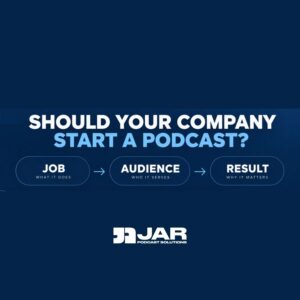
At JAR, we use a simple framework to work through these questions: the J.A.R. System. Job, Audience, Result.
- Job: What is the podcast supposed to do for the organization?
- Audience: Who is it for?
- Result: What evidence would tell us it is working?
Those questions sound simple, and they are. They’re also useful for challenging the idea that a company should make a podcast simply because somebody decided it “should have a podcast.”
A branded podcast should do something before it becomes more content
Podcasting is a mainstream media behaviour. Edison Research’s Infinite Dial 2026 found that 58% of Americans aged 12+ had listened to or watched a podcast in the previous month. Signal Hill Insights reported in 2025 that 46% of Canadian adults consumed podcasts monthly.
The definition has also expanded beyond the audio feed. In February 2025, YouTube announced more than one billion monthly active viewers of podcast content on its platform.
The larger point: podcasting is no longer confined to podcast apps, or even to audio. A show can reach people through audio, video, websites, newsletters and social channels.
That creates an opportunity for brands.
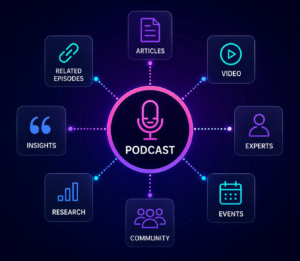
One strong conversation or narrative episode can supply original material for social clips, articles, newsletters, executive talking points, sales assets and campaign creative.
But that only works if the original thing is good.
The show needs a clear audience, a clear purpose and something interesting to say. The material that comes out of it also needs to be adapted for each platform. A LinkedIn audience has different expectations from a TikTok audience. Watching on YouTube is a different experience from listening through headphones on a commute.
Done well, a podcast can become a pillar asset: one substantial piece of original thinking and storytelling that supports a broader content program.
Done poorly, distributing the same mediocre material across more channels simply creates more mediocre content.
So the starting point cannot be:
“How many clips can we get out of this podcast?”
It has to be:
“What are we making that is worth turning into clips?”
And then:
“What should this become on each platform?”
How to choose a podcast partner: close enough to understand, outside enough to question
A useful podcast relationship sits somewhere between insider and outsider.
Your partner should get to know your organization well enough to understand the nuances. They should also bring a broader media perspective, editorial judgment, a commitment to fact-checking and an understanding of brand safety.
They should recognize when an executive is saying something new, and when they are repeating what everyone else is saying. They should notice timely themes in interviews and understand how those themes could support episode packaging and promotion.
They should highlight editorial blind spots that could cost the audience’s trust. They should understand the legal or regulatory sensitivities around the work.
They should also remain outside enough to say:
“I don’t understand that.”
“I’ve heard you say this three times. Is this actually the bigger story?”
“Your audience might care more about the other part.”
“This sounds like company language. How would a real person say it?”
When assessing a potential partner, ask them to explain:
- How they would learn your business and research the intended audience.
- How they would develop a distinctive editorial approach.
- Who would handle guest preparation, production and approvals.
- How they would support discovery and adapt content for different platforms.
- How they would measure performance and use it to improve the show.
You want somebody close enough to understand the shape of the company “jar,” but situated on the outside, so they can read the label.
You want a collaborative team that helps identify which parts of your work will be most compelling to the people you are trying to reach.
Hint: it’s not always what your CEO thinks it is.
Measure podcast success against its purpose
Downloads matter. Views matter too. But they are rarely the whole job.
Even the definition of a view matters. YouTube changed its view counting from August 24, 2026, counting views from the first frame across formats. It separately tracks engaged views, defined as clicking to watch or watching beyond the initial seconds.
An engaged view is useful context. It still doesn’t tell you how long someone stayed or whether the show achieved its purpose.
If the job is to demonstrate expertise to a specific audience, success may involve retention, relevant audience feedback, sharing and useful conversations elsewhere in the business. Audience profiles and survey responses can add context where that information is available. Standard podcast analytics cannot identify every listener or employer.
If the goal is recruitment, reputation, customer education, audience growth or lead generation, the measures may be different again.
That’s why measurement should begin when the podcast strategy begins.
First, define the job.
Then decide what evidence would tell you the show is doing it well.
Then, keep looking.
A podcast can develop over time. You can adjust topics, packaging, distribution and creative choices as you learn what resonates with the audience.
Your partner should help define the measures at the outset, track them over time and use what they learn to make the show better. For commercial goals, that may require evidence beyond platform analytics, such as audience research, attributed enquiries or documented sales-team use.
They should not disappear once the episode is exported.
An outside podcast partner can help build in-house capability
Some larger companies will eventually want to bring more of their podcast work in-house.
That can make sense.
But there’s a big difference between handing an internal team a production checklist and helping them build the capacity to run a strong show.
A good partner should help your team understand the whole system: editorial strategy, format, story selection, guest preparation, interviewing, production, distribution, measurement and learning from the audience.
In other words, they should help build judgment, not just hand over templates.
That might mean producing the first season together. It might mean training internal producers or marketers. It might mean creating workflows, editorial standards and measurement frameworks the team can use as more responsibility moves in-house.
We’ve seen that happen ourselves. After several seasons of working together on Disruptors, RBC had built the internal systems and capabilities to take the show in-house. John Stackhouse described JAR’s role in helping them get there this way:
“Disruptors would not be what it is today without JAR. Over 10 seasons, they helped shape our editorial direction, grow our audience, and build the production systems and internal capabilities needed to sustain our quality. Their expertise and commitment made them an invaluable partner, and we learned enormously from their team along the way.”
John Stackhouse, VP, Thought Leadership, RBC
You can read more about our work on RBC’s Disruptors.
That, to us, is what a strong partnership should look like.
The goal should be to leave a client with stronger instincts, stronger systems and more confidence than they had when the relationship began.
Even when production moves in-house, there can still be value in bringing in an outside editorial perspective from time to time.
Technical capability and editorial distance are two different things.
Sometimes you need both.
When does your company need an outside podcast partner?
An outside partner is worth considering when you have useful expertise to share, a specific audience to reach and a purpose for the show, but need editorial judgment, production capacity, audience development or help measuring the result.
If your internal team already has those capabilities and enough time to use them, you may need support with only part of the work. An editorial review, a strategy engagement or production support may be enough.
You probably don’t need to become a media company. You may need to lean into some of the things great media companies are good at:
- Editorial judgment.
- Curiosity.
- Consistency.
- Audience understanding.
- Strong storytelling.
- A recognizable point of view.
Some organizations will build those skills internally. Others will develop them with a partner. Some will keep an external editorial team in the mix.
Because even when the internal capacity is there, distance can still be useful.
A good partner can learn the business, understand the goals, strengthen the team and retain enough perspective to see the organization the way an audience does.
You can’t read the label when you’re inside the jar.
Have a show in mind, or one that needs a fresh perspective? Start a conversation with JAR about its job, its audience and what success should look like.