
Most brands that make a podcast still think about it as a show.
Make the episodes. Put them on Spotify, Apple Podcasts and YouTube. Chop them into clips. Write a few articles. Post everything to LinkedIn until LinkedIn begs for mercy.
All useful.
But I think there is a bigger opportunity:
What if the podcast became part of a larger body of work?
What is a podcast content hub?
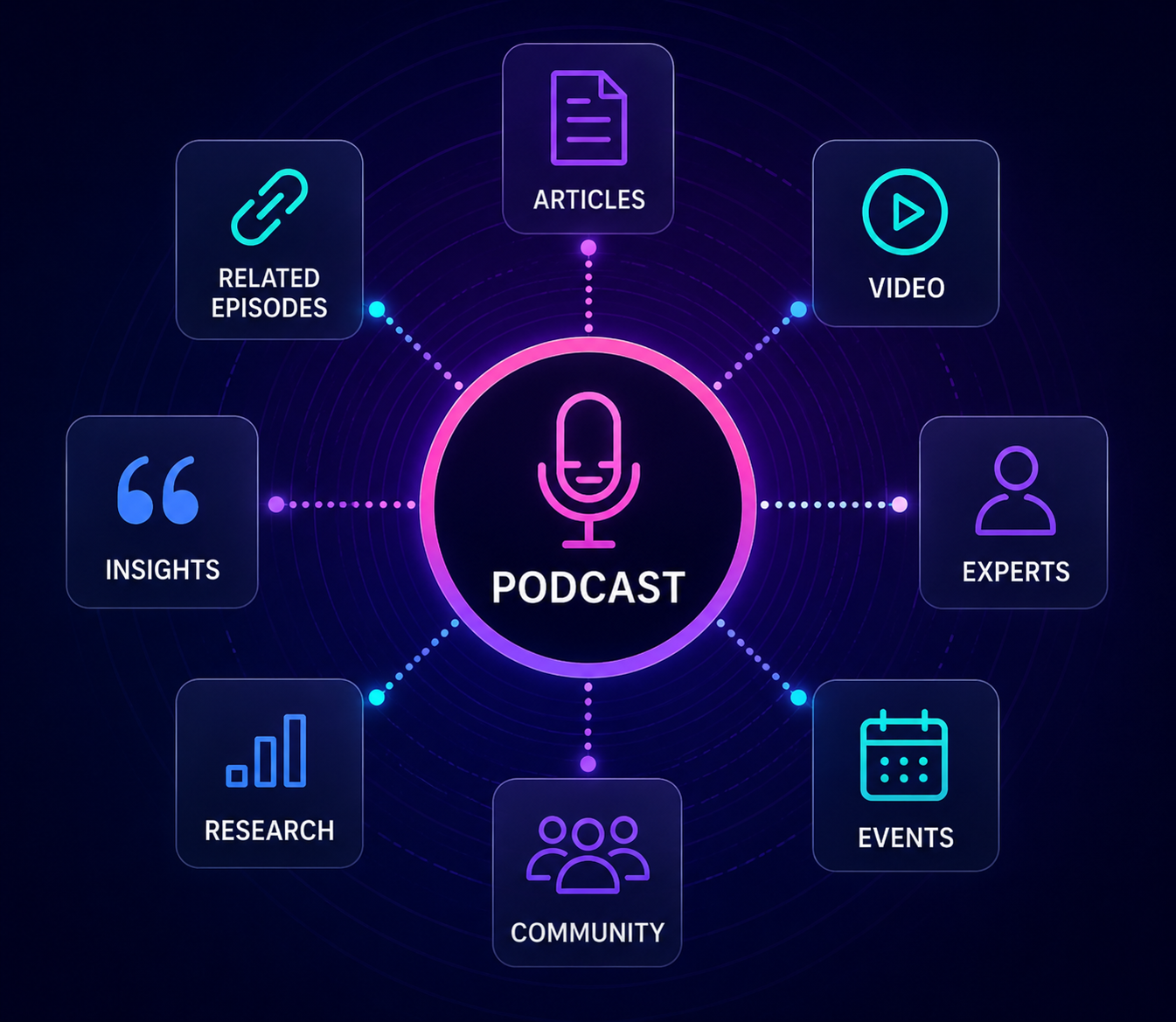
A podcast content hub is a connected body of podcasts, articles, research, video, events, expert perspectives and other useful material organized around ideas your organization cares about.
Instead of treating each podcast episode as an isolated piece of content, the hub connects that conversation to everything around it.
An episode leads to an article. An article connects to research. Research sparks another conversation. An expert appears in an event. An older episode suddenly becomes useful again.
The podcast becomes part of something bigger.
And over time, that something can become what your organization is known for.
I don’t necessarily mean a shiny new section of your website called CONTENT HUB, populated with 47 tiles.
I mean connecting the podcast back to the ideas your organization cares about.
How does one episode connect to another?
How does a conversation connect to your research, an article, a video, an event, or something excellent somebody else made?
And over time, how does all of that become something your organization can actually own, build on and be known for?
Because there is a crazy amount of competition for people’s attention.
Even a great podcast episode can disappear quickly into the feed.
But a great idea should not.
If you connect that idea to other episodes, research, articles, events, experts and conversations, it becomes part of an attributable body of knowledge. People can see where the thinking came from, who contributed to it, how it evolved and why your organization keeps returning to it.
Now the content is doing more than filling a content calendar.
It is building intellectual equity.
Your brand lives in the connections
A brand does not have to be plastered over every piece of content to be present.
Often, the brand shows up most clearly in the in-between spaces.
In the guests you bring together. The questions you keep returning to. The research you cite. The creators you support. The stories you emphasize that others ignore. The tone that carries from podcast to article to video.
And in the editorial judgement behind what belongs together in the first place.
The Masters of Scale Hub is a good, relatively simple example. It brings together shows like Masters of Scale, Rapid Response and Pioneers of AI.
Different shows. Different jobs. But they clearly belong in the same editorial world.
Together they say:
This is the world we pay attention to. These are the people we think you should hear from. These are the questions we think are worth your time.
That connective tissue is what builds respect over time.
It is also what makes the body of work attributable.
If the same sensibility, questions and editorial standards keep showing up, people begin to recognize the thinking behind the content.
If the curatorial approach makes good sense, the voice of the brand shines through even when the format, topic or speaker changes.
That is very different from renting a creator’s audience for one campaign and hoping some of the glow sticks.
As Mary Jubran, Audience Development Manager at JAR, notes:
“Bringing celebrities through to a little-known podcast is not necessarily going to be successful. You need to build your OWN identity first.”
A podcast content hub turns content into memory
IBM Think and Goldman Sachs Insights take this idea further.
Podcasts sit alongside articles, research, reports and video, organized around ideas rather than media format.
That means a strong interview from two years ago does not have to disappear beneath 86 newer episodes.
It can remain connected to a subject, a piece of research and other related thinking.
The organization develops memory.
You can see which questions it keeps returning to, what it knows, what it is still trying to understand and how its thinking changes over time.
That is valuable for an audience.
It is also extremely valuable for the brand.
Your experts are no longer contributing isolated quotes to isolated pieces of content. Their ideas start to accumulate under themes or headings.
Your research can be revisited rather than forgotten.
A new podcast episode can point back to an older one and say, in effect:
We’ve been thinking about this for a while.
That is how expertise becomes more coherent, recognizable and attributable.
RBC Disruptors is a good example.
We’ve produced the Webby award-winning show for RBC for several seasons, and it regularly connects into larger thought-leadership initiatives at the bank.
For instance, RBC’s research into the future of agriculture became The Growing Challenge, a special podcast miniseries looking at how Canada could produce more food while reducing emissions.
A few years later, agriculture resurfaced inside The Canada Project, this time through an episode about Saskatchewan, ag-tech and what Canada needs to build next.
Same territory.
New route in. New moment.
The value is in the continuity.
A research report does not die when the launch campaign ends. A podcast series does not vanish when the season wraps.
The ideas can reappear, evolve and connect with new questions.
That is the beginning of a body of thought.
The podcast becomes an editorial engine
Amazon offers a useful example of what this can look like in practice.
We produce This Is Small Business, which sits inside a broader small-business learning ecosystem that includes resources such as Amazon Small Business Academy, Seller University, live learning, events and entrepreneur stories.
The podcast gives those ideas people, voices and stories.
The surrounding ecosystem of clips, business accelerator events, educational guidelines and practical advice gives small business owners places to go deeper without leaving the Amazon universe.
Amazon is also doing something interesting with Learn and Be Curious with Doug Herrington, created for “Amazonians and the Amazon curious.”
The show is new, but it is already functioning as an editorial engine.
Amazon takes ideas and stories from individual episodes and develops them into standalone About Amazon articles.
A conversation with a fulfillment-center GM became a written piece about what an Amazon GM actually does all day. Conversations about pricing, grocery, AI shopping, and company culture have all been given another editorial life outside the podcast itself.
That is exactly the kind of connection I mean.
Podcast → idea → new story → larger body of work.
The important thing is that the idea does not stay trapped inside the episode.
It becomes searchable. Linkable. Reusable. Quotable. Connected to other material.
And, over time, associated with the organization that keeps creating and curating the conversation.
That is where a podcast starts behaving less like a campaign asset and more like intellectual infrastructure.
The podcast content hub becomes an ecosystem
Not everyone is built like Amazon.
Thankfully.
There are many ways to build a content hub.
HubSpot has built a podcast network, but it also invests in the creators behind those shows through funding, distribution, cross-promotion, coaching and production support.
The creators and voices it chooses to back become part of the brand.
TELUS STORYHIVE pushes that idea further, supporting emerging creators through funding, training, mentorship and distribution.
Red Bull Media House operates on a much larger scale, funding and producing work, developing talent and giving creators access to a vast international media and distribution ecosystem.
The content hub in these cases begins to feel more like a loose, creative ecosystem.
And I like what that says about the role a brand can play.
You do not need to be the smartest voice in every room.
You can help create the room.
That is still a form of authorship, just a more generous one.
The brand’s point of view shows up in who gets invited in, which ideas get resources, what quality bar gets set and what work gets amplified.
Creation matters, clearly.
But curation matters too.
Both can help build a recognizable body of work.
How do you build a podcast content hub? Start with one excellent flagship show.
This is the part I would emphasize most.
Looking at IBM Think, Red Bull or STORYHIVE can make all of this sound like you need six podcasts, an academy, a documentary unit and a CMS migration by Christmas.
You do not.
Dream big. But start with one excellent flagship show.
Make something useful enough that an audience will choose it.
Distinctive enough that they remember it.
Multi-dimensional enough that you can repurpose it across platforms.
And true enough to your organization’s culture and values that it could only really have come from you.
There is also a strategic reason to create some of that intellectual property yourself.
Creator partnerships can be fantastic. Creators bring established voices, credibility and communities.
But when all of your content lives through someone else’s audience and identity, a lot of the value accrues to them.
A flagship show gives you a chance to establish something more ownable.
You establish the editorial territory. You develop the voice. You build relationships with guests and experts. You learn which questions resonate. You create an archive of conversations that can be revisited and connected.
And, crucially, you start building a direct relationship with an audience around a body of ideas that is recognizably yours.
The show then starts teaching you what the larger hub could become.
Which subjects keep surfacing?
Where does the audience want to go deeper?
What deserves an article, a live event, more research or another series?
Which outside voices, celebrities, influencers, leaders or regular people, belong in the wider conversation?
Which themes are becoming part of what your organization is known for?
Your first podcast can teach you what the hub should ultimately become.
Consistency does not mean sameness
As the body of work grows, the challenge is keeping it recognizable across different shows and mediums.
That does not mean making everything sound identical.
A documentary, an executive interview show and a creator-led series should feel different.
If every host has been issued the same list of approved adjectives, something has gone horribly wrong.
Consistency comes from deeper choices.
What questions do you ask?
How do you treat guests?
How curious are you willing to be?
Do you make room for disagreement?
Do you embrace failures and share learnings from them?
Do you highlight and credit other people’s thinking if it moves the needle for everyone?
Do you trust the audience with complexity?
Those choices create voice too.
And over time, that consistency helps attribution.
People begin to recognize not only the logo, but the way your organization approaches a subject.
That is much harder to copy.
Podcast content hubs help people sift through the noise
Ultimately, all podcasting comes back to creating value for an audience.
And one of the most valuable things you can offer right now is help figuring out what deserves their attention.
There is obviously no shortage of content.
Podcasts, newsletters, videos, reports, hot takes, explainers, ragebait and now an industrial supply of AI-generated everything.
The problem is increasingly discernment.
What is worth my time?
Who should I listen to?
What is credible?
Where should I go deeper?
A strong podcast content hub can help answer those questions.
It can say:
We spend a lot of time in this world. We know some interesting people. We have been thinking about these questions. Here are some things, ours and perhaps other people’s, that we genuinely think deserve your attention.
Do that consistently, and the audience can begin to trust your taste, not only your expertise.
And that is where the larger brand value sits.
The podcast stops being a temporary piece of content and becomes part of an accumulating body of knowledge.
Ideas connect. Expertise compounds. Sources remain visible. The audience can trace the thinking back to the people and organization behind it.
Eventually, the brand becomes more than the name attached to the podcast.
It becomes the thing connecting the stories, people, ideas and questions.
The leader.
And the whole body of work starts saying something larger, and more ownable, than any single episode ever could.
Want your podcast to become more than a feed?
Explore how JAR approaches branded podcast strategy and see how brands are turning podcasts into measurable, long-term assets in our podcast case studies.