

Most creator marketing rents attention. Creator-led branded shows build an owned audience asset. Here’s how brands should choose creators, design shows, and create long-term business value.
Brands have spent years paying creators to talk about products.
The standard formula is familiar.
Find someone with a large following who seems compatible with the brand. Put the product in their hand. Give them a few talking points, a discount code and perhaps a houseplant to make the video feel intimate.
Rent their audience for 45 seconds.
Hope for the best.
There is nothing inherently wrong with this. The right creator partnership can generate awareness, sales and useful cultural relevance.
But it leaves an enormous amount on the table.
A creator can offer a brand more than a short burst of borrowed attention.
With the right concept, relationship and production support, a creator can become the centre of an original show people actively choose to follow.
That is the promise of a creator-led branded show.
What Is a Creator-Led Branded Show?
A creator-led branded show is an original audio or video series built around the right creator, funded by a brand, and designed to become an ongoing audience asset rather than a one-off campaign placement.
The brand may own the show outright or develop it in partnership with the creator. The creator may be a recognizable personality, an expert, a journalist, an entertainer, a community leader or someone with valuable lived experience.
What matters is not simply the size of the creator’s following.
What matters is whether the creator is right for the audience, the subject and the show itself.
A creator-led branded show gives the brand a recurring format, a growing content library and a direct relationship with an audience. It creates something people can discover, subscribe to and return to.
That is different from appearing briefly inside someone else’s content.
How Are Creator-Led Branded Shows Different From Influencer Marketing?
Influencer marketing usually begins with the creator’s reach.
A creator-led show begins with a strategic question: What is worth building together?
That distinction changes the entire process.
Traditional creator marketing often uses the creator as a media channel. The brand pays for access to an existing audience, the creator publishes the agreed content, and the value of the partnership declines quickly after the campaign ends.
Creator-led branded shows use the creator as part of the show’s creative foundation.
The creator does not merely deliver a message. They help determine the tone, shape the conversations and create the conditions that make the audience want to return.
Creator-led branded shows are not:
- Sponsorships inside an existing podcast
- Celebrity endorsements
- Influencer campaigns with microphones
- Branded interviews without a repeatable format
- Video series built around a product demonstration
- One-off content placements disguised as original programming
Most creator marketing rents attention.
A creator-led branded show builds an audience asset.
| Rented attention | Owned audience asset |
|---|---|
| One-off creator post | Recurring original show |
| Short campaign window | Long-term discovery |
| Audience belongs to creator or platform | Brand develops a direct audience relationship |
| Limited content lifespan | Growing content library |
| Creator delivers brand message | Creator helps carry the show |
| Campaign reporting | Ongoing audience and business measurement |
Why Brands Are Building Shows With Creators
Brands do not suffer from a shortage of content.
They suffer from a shortage of content that people deliberately choose.
A strong creator-led show gives the audience a reason to spend meaningful time with the brand. It can explore a subject with greater depth than a short social post, paid advertisement or product-led video.
It also gives the creator room to do what made them valuable in the first place.
They can tell stories, ask difficult questions, explain complex ideas, challenge assumptions and build an emotional relationship with the audience.
The brand benefits from the creator’s existing credibility. But the larger opportunity is to create a show capable of earning credibility of its own.
The Brand. Creator. Show. Framework
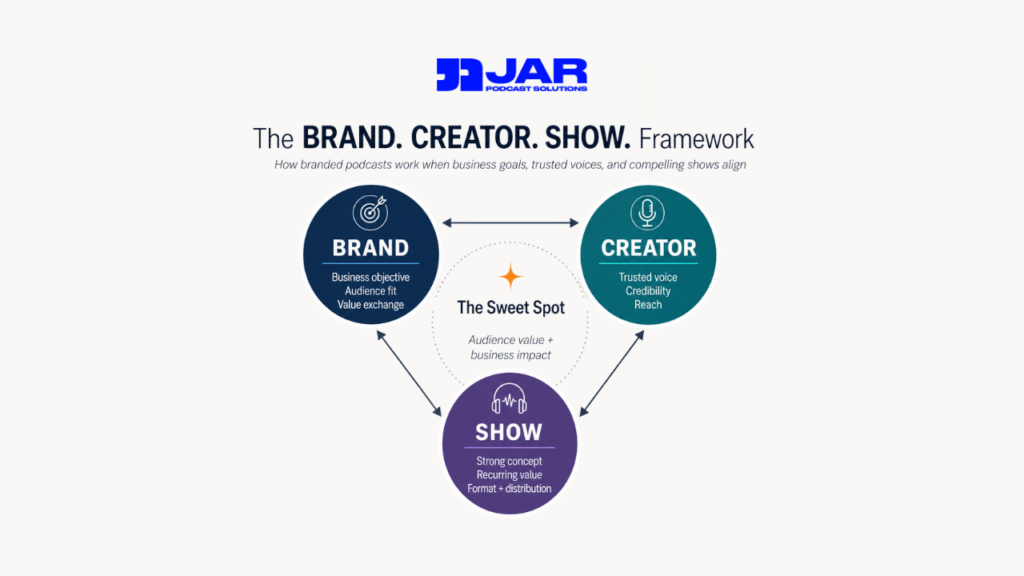
At JAR, we use a simple framework to evaluate creator-led branded shows: Brand. Creator. Show.
All three parts must work.
A famous creator cannot rescue a weak show.
A strong show concept will struggle with the wrong creator.
Neither will create much value if the brand has no clear reason for entering the conversation.
JAR Brand Creator Show framework for developing creator-led branded podcasts.
Brand: What Business Job Must the Show Perform?
Every creator-led show should begin with a business problem or opportunity.
Is the brand trying to:
- Help patients understand a difficult health issue?
- Make unfamiliar science more accessible?
- Change how a business category is understood?
- Build trust with a sceptical professional audience?
- Strengthen its relationship with a specific community?
- Give executives a more human public platform?
- Become a credible educator in its field?
- Create demand before buyers are ready to speak with sales?
The show’s job should be clear enough to influence every later decision.
Without a clear job, the show becomes expensive proof that the company owns microphones.
The objective does not need to turn every episode into a sales pitch. In fact, it should not.
It does need to explain why the brand is investing in the series and what evidence would indicate that the investment is working.
Creator: Who Has Credibility With the Intended Audience?
Brands often begin talent discussions with questions about fame and reach.
Who has the largest audience?
Who has the biggest name?
Who could create the largest launch-day spike?
Those questions have their place. But they do not tell you whether someone can carry an entire series.
Hosting is a particular skill.
- Can this person listen generously?
- Can they make complicated ideas understandable?
- Can they create chemistry with strangers?
- Can they handle emotional or vulnerable conversations without making them feel clinical or exploitative?
- Can they remain curious after launch week, when everyone has stopped sending congratulatory Slack messages?
The right creator may be well known. They may also be a respected expert with a smaller but highly relevant audience.
Credibility can come from professional expertise, lived experience, cultural fluency, humour, curiosity or a long-standing relationship with a community.
Reach matters.
Fit matters more.
Show: What Concept Is Strong Enough to Continue?
“We hired a popular person to interview interesting guests” is not a show concept.
A creator-led branded show needs a clear editorial promise.
The audience should be able to understand:
- What the show explores
- Who it is for
- Why this creator is leading it
- What happens in a typical episode
- Why they should return
The series also needs a repeatable structure.
That does not mean every episode must feel identical. It means the show has a recognizable identity and a format capable of producing more than one interesting conversation.
The concept must be larger than the creator’s current popularity and larger than the brand’s immediate campaign.
That is what gives the show room to grow.
What Is Creator-Show Fit?
At JAR, we call the alignment between the person and the program creator-show fit.
Creator-show fit is the degree to which a creator’s authority, audience relationship, temperament, hosting ability and commitment align with the needs of a particular show.
Follower count cannot tell you this.
Neither can a polished audition clip.
Creator-show fit requires examining the whole role the creator will play.
- Will they be interviewing experts?
- Telling personal stories?
- Explaining a complicated subject?
- Handling vulnerable conversations?
- Performing in front of a live audience?
- Carrying humour?
- Challenging guests?
- Representing the brand in public?
- Promoting the show through their existing channels?
The creator must feel natural inside the show’s world. They should not feel like a famous person flown in to lend temporary shine to an unrelated organization.
The strongest creator-led shows make the creator feel almost inevitable.
Creator-Show Fit in Practice
Dylan Marron and Skinquiries
The new season of Skinquiries, from iHeart’s Ruby Studio, is hosted by Dylan Marron. The series explores what it means to live with eczema and other visible or chronic skin conditions.
On paper, the subject is skin.
The deeper territory is self-consciousness, identity, healing and self-acceptance. It is also about the exhausting work of living in a body that attracts attention you did not request.
That is where Dylan becomes central to the design.
Dylan Marron is an award-winning writer, producer and performer whose work frequently explores empathy, identity and difficult human conversations.
He created and hosted the Webby-winning podcast Conversations with People Who Hate Me, in which he spoke directly with people who had posted hostile comments about him online. He also created Every Single Word, a video series examining racial representation in popular films.
His work is funny, thoughtful and unusually good at finding the human vulnerability beneath subjects that can otherwise become abstract or combative.
Dylan knows how to ask personal questions without making the conversation feel like an interrogation under fluorescent lighting.
He can move between humour and vulnerability without giving the audience emotional whiplash.
His role is larger than reading introductions and passing questions to a dermatologist.
He gives the show its emotional register.
A series may officially concern eczema, but its larger subject is the experience of living in a visible body. It explores the gap between how we see ourselves and how we fear other people see us.
Dylan is not being asked to impersonate a medical expert.
He creates the conditions in which patients and experts can speak honestly, clearly and humanely.
That is creator-show fit.

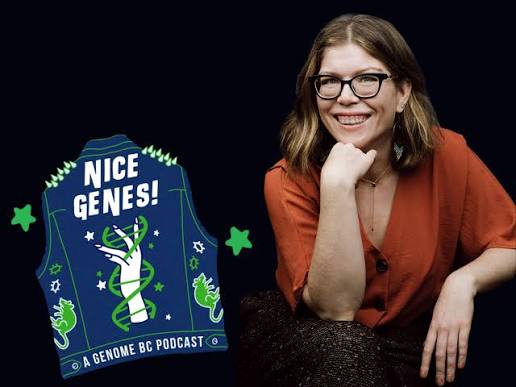
Dr. Kaylee Byers and Nice Genes!
Dr. Kaylee Byers is a scientist, science communicator and self-described “rat detective.”
Her research has included the genomics of urban rats in Vancouver’s Downtown Eastside and the connections between human, animal and environmental health.
She also hosts Nice Genes!, Genome BC’s award-winning podcast about genomics and the ways it shapes health, wildlife, food, climate and the world around us.
JAR produces the series.
Kaylee brings real scientific authority to the role. She is also funny, curious and comfortable admitting when something is strange, confusing or slightly disgusting.
That is useful when the subject includes sewage, infectious disease, ancient DNA, heroic rodents and the occasional genomic pun.
She is also an experienced live host.
Kaylee hosts Nerd Nite Vancouver, a live science series built around smart, funny talks on wonderfully specific subjects.
For a live taping of Nice Genes! at the H.R. MacMillan Space Centre, she drew an audience to the planetarium for an episode about the heritability of musical talent.
She could explain the science, work a live room, keep the conversation moving and, when required, sing.
Scientific authority, local credibility, stage presence, humour and musical talent are a fairly outrageous combination.
In podcast-host terms, she is almost suspiciously well-equipped.
Her relationship with Genome BC also feels natural. She is a British Columbia-based scientist whose work is rooted in the local environment and research community.
She already belongs in the show’s world.
Genome BC gains a host who understands the science, place and audience. Kaylee gains a well-produced platform through which she can bring complex ideas to more people.
She does not simply present the material.
She gives the show its tone, energy and credibility.
Borrowed Trust Is More Valuable Than Borrowed Fame
A creator brings an existing relationship with an audience.
That relationship may include familiarity, affection, authority or the simple belief that this person will not waste our time.
This is borrowed trust.
Borrowed trust is more useful than fame without relevance.
A widely recognized celebrity may create an initial spike in attention. But recognition alone does not guarantee that the audience will believe the person belongs in the conversation.
The creator should have a credible reason to explore the show’s subject.
That reason may be professional.
It may be personal.
It may come from a body of creative work or a long-standing relationship with a particular audience.
The brand benefits from that trust. But the goal should extend beyond borrowing the creator’s reach during launch week.
The show must eventually earn its own relationship with the audience.
Borrowed trust can open the door.
The show itself still has to furnish the room.
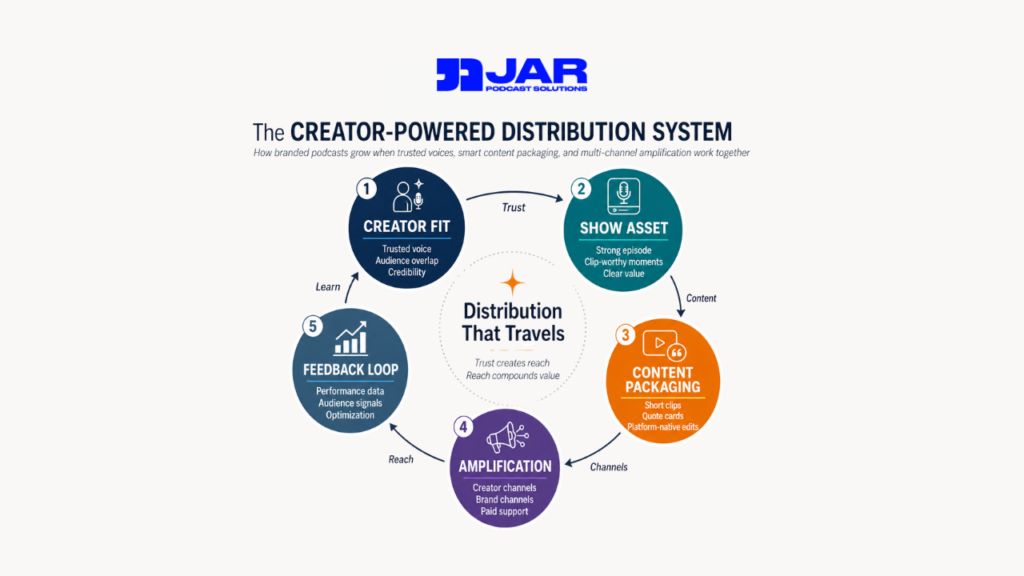
The Creator Must Be Part of the Distribution Strategy
Many brands hire a creator, record a show and assume the creator will naturally promote it forever.
This is a lovely dream.
It is also how uncomfortable conversations begin.
In a creator-led branded show, the creator’s promotional role should be discussed, designed and contracted from the start.
Questions should include:
- Will the creator announce the show?
- Will they post trailers?
- Will they share every episode or selected episodes?
- Will they record short-form video?
- Will the show appear in their newsletter?
- Will they promote live recordings?
- Will they share behind-the-scenes material?
- Will they participate in paid media?
- Will they allow the brand to use their likeness in promotion?
- What happens if their platform strategy changes?
This is creator-powered distribution.
Creator-powered distribution is a planned partnership in which the creator uses appropriate parts of their existing platform and audience relationship to support the launch and growth of the show.
The creator is part of the distribution strategy as well as the person behind the microphone.
That does not mean turning the host into a relentlessly cheerful billboard.
Promotion must feel natural within the creator’s existing relationship with their audience.
The brand and production team also have responsibilities.
They need to create trailers, clips, artwork and episode hooks the creator will feel good about sharing. They need to provide enough notice, make promotion easy and adapt the material for the platforms where the creator already has traction.
The brand should also support the show through its own channels, partnerships, paid media, employees, executives and customer communities.
Creator-powered distribution is a partnership.
None of it should be left to telepathy.
What Is the Brand Actually Building?
The strategic payoff of getting this right is an owned audience asset.
The brand is developing:
- An ongoing show
- A recognizable format
- A subscriber base
- A growing content library
- A body of intellectual property
- Searchable expertise
- A direct audience relationship
- A platform for creators, experts and executives
A strong episode can continue being discovered months or years after it is released.
It can be shared by sales teams, used in customer education, adapted into written articles, cut into short-form video or introduced to new audiences through search and recommendation.
A campaign placement disappears into the feed.
A show creates a body of work.
The creator gives the series a human centre.
The show’s architecture allows it to continue.
The brand develops an audience relationship over time rather than receiving a screenshot showing how many people viewed an influencer post on Tuesday afternoon.
Who Should Own a Creator-Led Branded Show?
Ownership should be discussed before development begins.
There are three common models.
1. Brand-Owned, Creator-Hosted Show
The brand owns the show, title, format, feed and underlying intellectual property. The creator is contracted as the host or creative partner.
This model gives the brand the greatest control and makes it easier to continue the show if the original creator leaves.
It also requires the brand to invest in building a concept that can become larger than one personality.
2. Creator-Owned Show Presented by a Brand
The creator owns the show. The brand funds or sponsors it.
This may feel more authentic to the creator’s existing audience and can move quickly if the creator already has a clear concept.
However, the brand is primarily supporting someone else’s asset.
That may be strategically sound. But it is not the same as building a brand-owned audience platform.
3. Co-Created or Co-Owned Show
The brand, creator and production partner share certain rights, responsibilities or revenue.
This can encourage stronger creator commitment. It can also become complicated.
The agreement should clearly address:
- Ownership of the title and format
- Feed ownership
- Rights to previous episodes
- Creator likeness and promotional usage
- Editorial control
- Revenue and sponsorship
- Exclusivity
- Termination
- Replacement of the host
- Sale or licensing of the show
- Use of clips and derivative content
There is no universally correct ownership model.
The right structure depends on the brand’s goals and the creator’s role.
Vagueness is not a structure.
Why Show Architecture Must Come Before Talent Shopping
Brands can become distracted by recognizable names.
That is understandable. Famous people look excellent on recommendation decks.
But creator selection should follow show architecture.
It should not replace it.
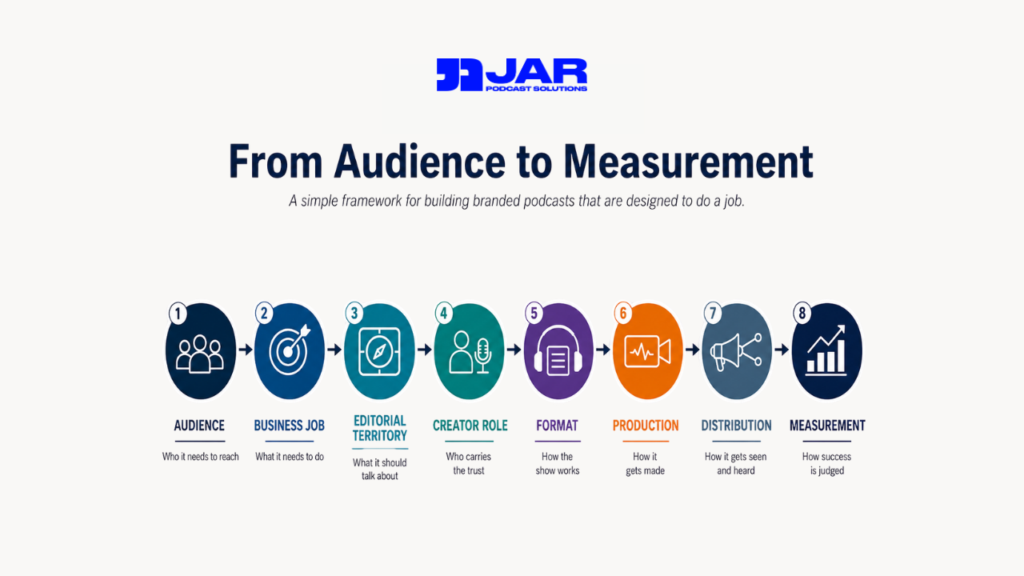
At JAR, show architecture includes:
- The intended audience
- The business objective
- The audience’s unmet need
- The brand’s authority to participate
- The editorial territory
- The creator’s role
- The format
- The episode structure
- The production approach
- The distribution system
- The measurement plan
This keeps the process grounded in strategy.
The job is not to find someone recognizable and build a podcast around whatever they happen to enjoy discussing.
There are already enough podcasts following that formula. Most do not stand out.
The job is to identify the point where the brand’s purpose, the creator’s credibility and the audience’s authentic interest overlap.
That is where a durable show can grow.
How to Choose the Right Creator for a Branded Show
The creator search should begin with a role description, not a list of famous names.
Evaluate Subject Authority
Does the creator have a credible relationship with the subject?
They do not always need formal credentials. But they need a reason to be there.
Evaluate Audience Relevance
Is the creator trusted by the people the brand wants to reach?
A smaller, relevant audience may be more valuable than a large, general one.
Evaluate Hosting Ability
Can the creator listen, react and follow an interesting idea?
Good social content does not automatically translate into good long-form conversation.
Evaluate Emotional Range
Can they handle humour, tension, uncertainty or vulnerability when the subject requires it?
Evaluate Reliability
Will they prepare, attend recordings and sustain their energy across a full season?
The creator must still care after the launch announcement.
Evaluate Distribution Commitment
What promotional support are they willing to provide?
Get specific.
Evaluate Brand Compatibility
Can the creator work within the legal, reputational and editorial realities of the brand without losing what makes them interesting?
The answer should not require sanding away their entire personality.
Evaluate Long-Term Fit
Could the relationship support more than one season?
Would the show survive changes in the creator’s platform, reputation or availability?
The goal is not to find the safest person.
It is to find the right person with a manageable risk profile.
How Should Creator-Led Branded Shows Be Measured?
Creator-led branded shows should not be judged solely by downloads or video views.
Those numbers matter. They are not the business outcome.
Measurement should connect audience behaviour to the job the show was designed to perform.
Audience Development Metrics
These indicate whether the show is reaching and retaining the right people.
They may include:
- Qualified reach
- Subscriber growth
- Episode completion
- Average consumption
- Returning audience
- Video watch time
- Search discovery
- Newsletter sign-ups
- Audience demographics
- Geographic relevance
Brand Metrics
These indicate whether the show is changing the audience’s relationship with the brand.
They may include:
- Brand awareness
- Brand favourability
- Trust
- Consideration
- Message association
- Category authority
- Executive visibility
- Share of conversation
Business Metrics
These connect the show to commercial activity.
Depending on the objective, they may include:
- Influenced pipeline
- Lead quality
- Sales enablement use
- Customer education
- Event registrations
- Recruitment
- Partner engagement
- Website behaviour
- Conversion activity
Not every metric should carry equal weight.
The measurement plan should follow the show’s business job.
Otherwise, the report becomes a large collection of numbers wearing business casual.
What Makes a Creator-Led Branded Show Successful?
A successful creator-led branded show usually has six things.
1. A Clear Business Job
The brand knows what the show is meant to change.
2. A Specific Audience Promise
The audience understands why the show is worth its time.
3. Strong Creator-Show Fit
The creator belongs inside the subject and can carry the format.
4. A Repeatable Editorial Concept
The series is more than a collection of unrelated interviews.
5. Planned Distribution
The creator, brand, guests, partners and paid media each have defined roles.
6. Useful Measurement
The brand can determine whether the show is reaching the right audience and performing its intended job.
Remove any one of these and the show becomes harder to sustain.
When Should a Brand Create a Show Instead of Sponsoring One?
Sponsoring an existing creator podcast may be the better decision when:
- The brand needs reach quickly
- The creator already owns the perfect audience
- The campaign is short-term
- The brand does not want to operate a content property
- The objective is direct response
- The brand has limited internal support
A creator-led branded show may be the better decision when:
- The brand wants to build long-term authority
- The subject requires depth
- The audience is difficult to reach through traditional advertising
- The brand has valuable expertise but lacks a human voice
- The company wants a reusable library of content
- The brand needs stronger audience trust
- The creator can bring both credibility and distribution
- The series can support multiple business functions
Sponsorship rents access to an audience.
A show gives the brand the opportunity to build one.
What Industries Can Use Creator-Led Branded Shows?
Creator-led branded shows can work in almost any category where trust, education or identity influences behaviour.
They are especially useful in:
Healthcare and Life Sciences
Patients and caregivers often need credible, human explanations of complicated subjects.
The right creator can make difficult medical conversations feel understandable without pretending to replace clinical expertise.
Financial Services
Money is personal, emotional and often intimidating.
A trusted creator can help audiences approach financial ideas through real questions and lived experience.
Technology and Artificial Intelligence
Technical subjects need interpreters.
Creators with professional credibility and communication skill can make unfamiliar systems useful to business audiences.
Science and Research
A strong science communicator can bring research into everyday life without flattening its complexity.
Education
Teachers, researchers and subject specialists can turn institutional knowledge into ongoing public programming.
Consumer Brands
Creators can help brands explore the culture, behaviour and identity surrounding a product category rather than discussing the product itself.
Professional Services
Experts, industry operators and respected commentators can help firms build authority with narrow, valuable audiences.
The category matters less than whether the brand has a legitimate role in the subject.