

Is Your Industry Too Boring for a Podcast? Use This 10-Minute Test
Can a supposedly boring industry make a good podcast?
Yes.
A podcast for a boring industry works when it helps a specific audience understand or solve a problem they genuinely care about.
The subject could be insurance, cybersecurity, data management, enterprise technology or quantum computing. The strategy remains much the same: define the job of the show, sharpen its editorial position, choose a format that supports the central idea and build each episode around tension, consequence or change.
First things first, though. Please imagine this article with a backing track of “I’m Too Sexy.”
Got it? Good. We can continue.
Over years of producing podcasts with different organizations and brands, we have learned that some industries consider themselves too dull, too technical or too relentlessly fact-based for podcasting.
You know the ones.
Insurance. Cybersecurity. Data management. Enterprise technology. Quantum computing.
These industries are packed with intelligent people doing important work. Their terminology can also make an innocent bystander feel like someone has started explaining blockchain at a wedding.
The people inside these fields understand the stakes. They know the characters, conflicts, tiny breakthroughs and occasional disasters hiding beneath the technical language.
The rest of us hear “enterprise server infrastructure” and begin thinking about lunch.
That can make organizations nervous about podcasting. Podcasts are often described as intimate, conversational and story-driven. How can a highly technical company compete in a medium filled with comedians, celebrities, murder investigations and people revealing things they have never told their mothers?
The answer is strategy.
Key takeaways
- A specialized subject becomes interesting when it addresses a meaningful audience problem.
- A topic needs a distinct editorial position before it becomes a viable podcast.
- The show’s format should express its central idea.
- Technical information needs tension, consequence or change to create movement.
- A focused audience can be more valuable than a large, vaguely interested one.
Can a boring industry make a good podcast?
A podcast does not need to make an entire industry universally exciting.
It needs to make a particular subject useful, interesting or meaningful to a particular group of people.
That is a much more manageable assignment.
A trade credit insurance podcast probably does not need to become the next Serial. It might need to help business leaders understand risk before an unpaid invoice turns into an expensive smoking crater.
A technology podcast may not need millions of listeners. It may need to give a sales team a credible way to begin conversations with several hundred valuable prospects.
An educational podcast may need to help customers understand a complicated product. A thought-leadership series may need to make an organization’s experts more visible and useful.
“Everyone” is rarely the audience.
Especially when the show concerns quantum annealing.
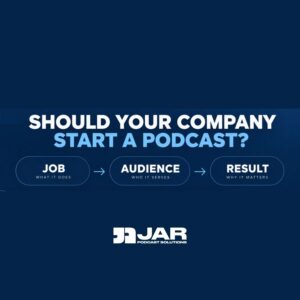
Start with Job, Audience, Result
At JAR, we use a simple framework called Job, Audience, Result.
Job
What business job is the podcast being hired to do?
The job could involve educating customers, supporting sales conversations, strengthening the brand’s authority or helping an organization become associated with a particular issue.
Audience
Whose attention does the show need to earn?
Avoid broad descriptions such as “technology leaders” or “business decision-makers.” Identify the people involved, the decisions they face and the pressures surrounding those decisions.
Result
What should change because the podcast exists?
The audience might better understand a complicated issue. Sales teams might have a useful reason to reconnect with prospects. Internal experts might become recognized voices within the category.
This framework becomes especially important when the subject is specialized. It prevents the podcast from becoming a collection of loosely connected interviews held together by a logo and good intentions.
A topic alone does not create a podcast
When people say an industry is too boring for podcasting, the proposed show often lacks a strong frame.
“Let’s make a podcast about quantum computing” is a topic.
“Let’s make the quantum-computing podcast focused entirely on practical applications” is a position.
“Let’s interview technology leaders” is a topic.
“Let’s make a show for CIOs balancing the promises of AI against real budgets, security risks and aging infrastructure” is a position.
“Let’s explain trade credit insurance” is a topic.
“Let’s build a game show around the risks businesses take every day” is a format.
This is where the interesting work begins.
A clear position tells the audience why the show exists and why they should choose it over every other interview podcast in their feed.
Turn the central idea into a format
A strong podcast format can make an abstract subject tangible.
It gives the listener a recognizable ritual. It also gives each episode movement.
The format should do more than decorate the show. It should communicate something about the idea behind it.
How Wheel of Risk made trade credit insurance tangible
With Wheel of Risk, produced for Allianz Trade, we were dealing with trade credit insurance, a subject many people cannot confidently define without looking it up.
Trade credit insurance is fundamentally concerned with managing risk. Business itself is a constant negotiation between risk and reward.
So we turned the podcast into a game show. We built the format around the central tension in trade credit insurance: risk. The result wasn’t just creatively different. Downloads increased 83% from Season 1 to Season 2, while followers grew 1,325%.
Game-show music prevailed. Guests spun a Wheel of Risk to reveal the subject of the day.
The device gave the show energy and suspense while creating room for serious conversations about unpaid invoices, fraud, unstable markets, supply chains and financial exposure.
The wheel was not decorative. It expressed the central idea of the show.
Every business decision contains uncertainty. Spin the wheel and find out what kind you are dealing with today.
This does not mean every insurance podcast needs a giant wheel, a gong or a host wearing a sequined dinner jacket.
Although none of those things should be dismissed prematurely.
It means the form of the show should help communicate its central idea.
Own a specific corner of the conversation
A specialized podcast becomes stronger when it can clearly claim a distinct part of the broader conversation.
Trying to cover everything usually produces a generic show.
A sharper editorial promise makes it easier for the right listener to understand why the podcast is relevant to them.
How Quantum Matters focused on practical applications
With Quantum Matters, hosted by D-Wave’s Murray Thom, the challenge was different.
Several podcasts already cover quantum computing. Many lean into its mind-bending possibilities: particles behaving like waves, information existing in multiple states and computers appearing to take shortcuts through reality.
Quantum Matters needed a sharper reason to exist.
The answer was practical application.
The podcast focuses on how quantum computing is being tested and applied by D-Wave and its industry and academic partners.
It asks:
- What are people doing with the technology?
- What problem are they trying to solve?
- Is this a real application?
- What happened?
- What did they learn?
Those questions create a clear editorial filter. Potential subjects either fit the show’s promise or they do not.
The podcast does not need to explain every part of quantum computing. It needs to own the conversation about where the technology is being put to work.
Define the audience through its real constraints
“For technology leaders” is not a meaningful audience definition.
There are plenty of shows featuring executives talking about digital transformation, innovation and the glittering technological future waiting just over the horizon.
Most CIOs are not working in a futuristic laboratory with an unlimited budget and a mandate to get humanity to the moon.
They are trying to modernize complicated systems while keeping the existing organization running.
They are being asked to respond to AI, improve security, reduce costs and manage technical debt. They must then explain their decisions to people who may still struggle to unmute themselves on Zoom.
That working reality is far more useful than a broad demographic description.
How The Savvy CIO reflects the audience’s working life
For The Savvy CIO, produced for Park Place Technologies, we sharpened the audience definition.
The show is for technology leaders balancing large expectations against real budgets, existing infrastructure and genuine security constraints.
Its guests are voices from the trenches. They have made difficult technology decisions, dealt with the consequences and, in many cases, bought the T-shirt.
The slogan, “Modernize wisely,” captures the editorial idea.
The podcast explores what to change, what to keep and how to move forward without accidentally setting fire to the engine room.
That audience definition affects the guests, questions, stories and tone of the show.
The more precisely you understand the listener’s working life, the less likely the podcast is to drift into generic thought-leadership fog.
Find the human problem inside the technical subject
A common mistake is building episodes around what the organization wants to explain:
“Our technology.”
“Our methodology.”
“Our services.”
“Our exciting new platform architecture.”
Very few people wake up desperate to hear a company explain its platform architecture.
They may wake up worried about a security breach. An audit. A stalled project. An unreliable supplier. A multimillion-dollar technology decision they do not completely understand.
That is where the story begins.
The organization’s expertise still matters. It becomes useful after the podcast has established a problem the audience recognizes.
Before working on these shows, I could not have given you a confident definition of trade credit insurance, quantum computing or data-centre cooling.
Now, thanks to some accessible storytelling, I have at least a vague idea.
But I am largely beside the point.
The intended audience needs to see its problems reflected in the show. It needs to learn something useful. Over time, it may begin to trust the organization behind the podcast.
Give technical information somewhere to go
Technical podcasts struggle when they become repositories for facts.
A good episode needs movement.
Something is at risk. A decision must be made. A commonly accepted belief turns out to be wrong. Someone tried something and failed. A new technology created a problem while solving another.
The material still needs a story.
That does not require turning a cybersecurity discussion into The Bourne Identity.
Although I would not reject this out of hand.
It means organizing information around tension, consequence and change.
Consider the difference.
AI governance
Topic: AI governance.
Story question: What happens when the AI system your company rushed to adopt is audited?
Trade credit insurance
Topic: Trade credit insurance.
Story question: What do you do when your largest customer suddenly cannot pay?
Data-centre infrastructure
Topic: Data-centre infrastructure.
Story question: How do you modernize critical systems without disrupting the operations that depend on them?
Quantum computing
Topic: Quantum computing.
Story question: Is anyone using this technology to solve a real problem today?
The technical material remains intact. It now has a direction.
What can a technical podcast do for a business?
For specialized organizations, the value of a podcast often extends beyond the size of its public audience.
Support sales conversations
Sales teams can share an episode addressing a prospect’s specific problem. That is more useful than another “just checking in” email floating through the digital void.
Educate customers
Complicated products and services become easier to understand when experts explain them through examples and real situations.
Create a focused storytelling platform
A podcast provides room to explore customer experiences, partner initiatives and industry changes with more depth than a social post or product page.
Develop internal experts
Employees can build recognizable voices and ideas instead of appearing occasionally as quotations in corporate announcements.
Show how the organization thinks
A useful podcast reveals judgment and curiosity. The audience hears how the organization approaches difficult questions without forcing the host to announce how impressive everyone is.
Nobody likes a brag.
Feed other marketing channels
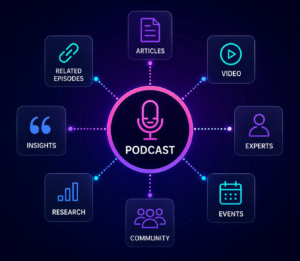
One substantive conversation can be adapted into articles, newsletters, sales resources, videos and social posts.
This works best when those uses are planned before the interview rather than discovered three weeks later in a mild content panic.
Why a niche podcast audience can be an advantage
Mass appeal receives a great deal of attention in podcasting. Relevance is often more valuable.
A cybersecurity company does not necessarily need an audience the size of Belgium. It may need the attention of the people responsible for cybersecurity budgets.
A quantum-computing company does not need my mother to understand quantum annealing. It needs researchers and technical decision-makers to understand where the technology may be useful.
A trade credit insurer does not need to become a household name. It needs to become credible and memorable among people concerned about unpaid invoices and financial exposure.
A company serving budget-conscious CIOs does not need to compete with every general technology podcast. It needs to speak honestly to people making consequential decisions under imperfect conditions.
That is the advantage of a focused podcast.
It allows an organization to spend meaningful time with a relatively small group of people whose attention is genuinely valuable.
The real danger is vague podcast strategy
A show becomes dull when it lacks a clear audience, a meaningful question or a reason to exist beyond “our competitors have podcasts.”
It becomes interesting when it understands the problem it is helping someone solve.
Your industry or brand is probably not too boring for podcasting.
The idea may still be too broad. The proposed show may be too inward-looking or too attached to the organization’s vocabulary. The team may be eager to explain the product before establishing why anyone should care.
Those problems can be fixed.
Give the show a format that expresses its central idea.
Claim an editorial position other podcasts have ignored.
Define the audience according to the pressures and limits shaping its working life.
Then use Job, Audience, Result to keep the entire strategy honest:
- What job is the show doing?
- Who is it doing that job for?
- What result would make it worth producing?
You do not have to make insurance sexy.
You do need to give people a reason to listen.