

You have $100,000 earmarked for podcasting.
What should you actually do with it?
Option one: Make your own branded podcast.
Option two: Buy advertising on podcasts your audience already listens to.
Option three: Build the podcast and use paid media to make sure somebody actually finds it.
These are three different investments.
Yet brands routinely lump them together because they all involve people talking near microphones.
Bad idea.
A branded podcast builds an owned media asset.
Podcast advertising buys temporary access to someone else’s audience.
One isn’t inherently smarter than the other.
The right answer depends on the job.
And sometimes, despite the fact that we run a branded podcast agency, the answer is:
Don’t make a podcast. Buy the ads.
Here’s how to decide.
Branded podcast vs. podcast advertising: the answer in 30 seconds
Use this first.
| If you need to… | Start with… | Why |
|---|---|---|
| Reach an existing audience quickly | Podcast advertising | The audience already exists |
| Support a short-term campaign | Podcast advertising | You can turn spend on and off |
| Generate response to a clear offer | Podcast advertising | Easier path from impression to action |
| Target specific markets or audience groups | Podcast advertising | Media can be bought against the target |
| Explain a complex issue | Branded podcast | You need more than 30 seconds |
| Build authority around a category | Branded podcast | Repeated useful content can compound |
| Build deeper trust with a niche audience | Branded podcast | The audience chooses to spend time with you |
| Create reusable long-form IP | Branded podcast | You own the recordings and derivative content |
| Support a long enterprise buying cycle | Branded podcast | Content can educate before and between sales conversations |
| Build an owned audience and accelerate its growth | Both | Create the asset, then buy relevant distribution |
If that answers your question, splendid.
If you’re about to ask Finance for six figures, keep reading.
First decide the job
This is where most podcast decisions go wrong.
The conversation starts with:
“Should we have a podcast?”
That’s backwards.
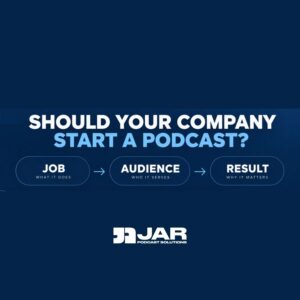
At JAR, The J.A.R. System starts somewhere else:
Job. Audience. Result.
Before deciding whether to make or advertise on a podcast, finish these three sentences:
JOB: We need podcasting to help us ____________________.
AUDIENCE: The people whose attention matters are ____________________.
RESULT: If this works, we should see ____________________.
Now the choice gets easier.
For example:
We need podcasting to generate awareness of a new product with 35-to-54-year-old homeowners in four states over the next eight weeks.
That sounds like a media job.
Buy the audience.
Compare that with:
We need to become a more trusted source for CIOs trying to understand how AI changes enterprise infrastructure decisions over the next two years.
That’s a content and authority job.
Building an owned show starts making more sense.
The medium didn’t change.
The job did.
If you’re still struggling to articulate that job, start with these five questions for developing a podcast idea before you spend anything.
The fundamental difference: buying attention vs. earning it
Podcast advertising takes advantage of an audience somebody else already did the hard work of building.
You identify shows that reach the right people.
You buy:
- Host reads
- Announcer reads
- Sponsorship integrations
- Branded segments
- Programmatic inventory
- Other targeted podcast placements
When the campaign runs, you get access.
When you stop paying, the access largely stops too.
A branded podcast works differently.
You create something people choose to consume from your brand.
That means developing:
- An editorial position
- A repeatable format
- Hosts or storytellers
- Guests
- Original conversations
- Video
- Audio
- An archive
- Subscribers
- Derivative content
- An audience relationship
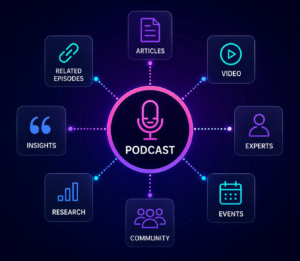
This is why we think about podcasts as more than production projects. Done well, they can become part of a much larger content and marketing system.
But owned media takes longer.
Nobody launches Episode One on Tuesday and wakes up Wednesday as NPR.
When podcast advertising is the smarter decision
1. You need reach now
This is the cleanest case.
Suppose you’ve got:
- A new product launch
- An event
- A report
- A promotion
- A defined campaign period
- A clear landing page
- A measurable conversion
Your primary problem is distribution.
Not content.
Podcast advertising lets you borrow an established relationship instead of spending months trying to build one.
What to do tomorrow:
Write down your campaign window.
If the business result needs to happen in the next 30, 60 or 90 days, ask whether building a new audience from zero is really necessary.
Quite often, it isn’t.
2. The audience already exists somewhere obvious
Say you want to reach financial advisors.
Or software developers.
Or golfers.
Or parents.
Or small-business owners.
There are already podcasts serving these people.
If your goal is simply to get a message in front of them, creating another show may be an unnecessarily scenic route.
What to do tomorrow:
List 10 podcasts your ideal buyer already listens to.
If you can identify those shows more easily than you can describe what your own show would uniquely contribute, investigate advertising first.
JAR’s guide to podcast audience growth explains how targeted podcast-to-podcast advertising can also be used to bring listeners into an owned show.
3. You have a clear direct-response job
Imagine your funnel already works.
You know:
- The offer
- The CTA
- The landing page
- The conversion event
- What a lead is worth
You need qualified traffic.
That’s a good media problem to have.
A podcast is not automatically improved by becoming content.
Sometimes an ad should simply be an ad.
4. You don’t have enough editorial territory
This is where brands get themselves into expensive trouble.
“We could interview our executives.”
Fine.
About what?
“We could talk about industry trends.”
For how many episodes?
“We’ve got some customers.”
Do they have anything interesting to say?
Before committing to production, run the concept through The 5 Questions That Turn a Podcast Idea Into a Real Show.
Then look at 5 Signs Your Podcast Idea Isn’t Ready Yet.
If you cannot clearly define the audience, editorial position and repeatable episode engine, don’t compensate with nicer microphones.
5. Your company won’t support the thing
A strong show requires access.
Executives need to participate.
Subject-matter experts need to give you time.
Legal needs to behave like a partner rather than a bunker.
Marketing needs to distribute the content.
Someone needs to care after Episode Two.
An agency can reduce the workload.
It cannot cure indifference.
If internal support is weak, media may be the cleaner buy.
When you should build a branded podcast
The case changes when the marketing problem requires depth, repetition or ownership.
1. Buyers need to understand something complicated
This is common in:
- Enterprise technology
- Financial services
- Healthcare
- AI
- Cybersecurity
- Infrastructure
- Consulting
- Professional services
A 30-second ad can introduce a claim.
It can’t always make someone understand why the claim matters.
That’s where long-form earns its keep.
Proof: American Express
American Express didn’t build Build It Braver around product features.
The show paired early-stage business owners with experienced entrepreneurs to work through actual business problems.
That mechanism matters.
Instead of saying:
“American Express supports small business.”
The show demonstrated support through useful mentorship.
The result:
- 90% listen-through rate
- 6% lift in brand awareness
- 6% lift in consideration
The show was also promoted through American Express CRM and with a placement on SmartLess.
That’s a useful distinction.
The owned content created depth.
Distribution helped people find it.
You can see exactly how JAR approached Build It Braver in the American Express case study.
2. You need people to trust how your company thinks
Awareness asks:
Have you heard of us?
Trust asks:
Do I think these people understand my world?
Those are different jobs.
In complex B2B categories, buyers may spend months forming opinions before speaking to Sales.
Good long-form content can influence that period.
Not by repeatedly telling people you’re a leader.
By repeatedly being useful.
If brand perception is one of the jobs, JAR’s guide to using branded podcasts to increase brand lift gets more specific about how to measure awareness, favourability and intent rather than simply assuming “thought leadership” happened.
3. You want to own a conversation
Consider AI.
There are approximately nine billion pieces of content discussing the future of AI.
That’s an estimate.
A very scientific one.
A generic show about “AI transformation” adds little.
But a show about:
How enterprise leaders decide which AI projects are actually worth funding
has a position.
So does:
What happens when AI implementation fails inside a large organization
Or:
Where AI is creating measurable value right now
That’s what Wharton and Accenture did with Where AI Works.
Instead of treating AI as an abstract future trend, the show focused on real-world applications and the business decisions sitting underneath them.
JAR helped shape the editorial direction, season structure, guest selection, scripting, production and analytics.
See how Wharton and Accenture built Where AI Works.
The subject isn’t the strategy.
The position is.
4. You have a small but valuable audience
This matters enormously in B2B.
Suppose your total meaningful market consists of 2,000 people.
If 400 of them regularly spend 30 minutes with your content, is that small?
Depends what those 400 people buy.
This is why podcast KPIs should start with the job, not an arbitrary download target.
A show designed to reach a niche group of senior buyers should not be judged by the same standard as a mass-market entertainment podcast.
Ask instead:
- Are the right people listening?
- Are they staying?
- Are they returning?
- Are they sharing?
- Are Sales teams using the content?
- Are target accounts engaging?
- Is the podcast showing up in conversations?
- Is brand perception changing?
Downloads are evidence of activity.
They are not, by themselves, evidence of success.
When the best answer is both
This is probably the most interesting model.
Make the asset.
Then buy the audience.
JAR has done exactly this.
Proof: RBC Disruptors
When JAR began working on RBC’s Disruptors, the podcast already existed.
The problem wasn’t simply production.
It wasn’t growing enough.
So the mechanism changed.
JAR:
- Improved production.
- Moved beyond the single-interview format into panels, sequential storytelling and remote cut-ins.
- Focused the editorial territory around innovation, climate and business strategy.
- Built a six-part promotion plan.
- Cross-promoted with relevant Canadian business podcasts.
- Bought placements on shows including TED Business and The Intelligence.
- Used John Stackhouse’s LinkedIn presence.
- Pursued earned media.
- Pitched Apple Podcasts.
- Used behavioural data to refine the strategy.
That’s considerably more useful than saying:
“We marketed the podcast.”
What happened?
- 500% growth in listenership
- 1.5M+ downloads
- 760,754 unique listeners
- 80% episode completion
- #1 in Entrepreneurship on Apple Podcasts Canada
Read the RBC Disruptors case study to see the full approach.
That’s the build-and-buy model.
The content gave people a reason to listen.
Paid, owned and earned distribution gave them opportunities to find it.
And this is precisely why audience growth needs to start before Episode One, rather than appearing as a panicked line item after the first three episodes underperform.
Another example: Allianz Trade
Trade credit insurance is a useful test because the category doesn’t exactly scream:
Cancel my plans. A new episode dropped.
JAR and Allianz Trade built Wheel of Risk around the thing people actually care about:
Risk.
Then they made the format a game show.
Again, the mechanism matters.
It wasn’t:
Make insurance more engaging.
It was:
Move the editorial focus from the insurance product to the risky business decisions the audience already deals with, then use a game mechanic to make those decisions entertaining.
That kind of format choice is strategic, not cosmetic. If you’re wrestling with the same decision, our guide to choosing a podcast format that actually fits the business job walks through the tradeoffs.
Distribution mattered too.
A subscriber campaign was designed to convert listeners into followers.
The results:
- 83% increase in downloads from Season 1 to Season 2
- 1,325% growth in podcast followers
- 69% average episode consumption
- #1 in Management on Apple Podcasts in the U.S.
Read the full Allianz Trade case study.
Idea.
Mechanism.
Distribution.
Result.
That’s the standard.
Use this build, buy or both scorecard
Here’s the part to steal for your next planning meeting.
Give yourself one point every time you answer yes.
BUILD
-
Does the audience need substantial education before buying?
-
Is trust or authority an important part of the buying decision?
-
Do we have proprietary expertise, people, stories or access?
-
Can we sustain at least 8–10 genuinely useful episode ideas?
-
Would long-form conversations create useful material for other channels?
-
Is the audience strategically valuable even if it is relatively small?
-
Do we want to own the IP and audience relationship?
-
Can we support this consistently for at least a season?
6–8 yes answers: Strong case for building.
4–5: Maybe. Pressure-test the concept first.
0–3: Don’t order the neon studio sign yet.
BUY
Now give yourself a point for each yes:
-
Do we need significant reach within the next 90 days?
-
Is there a defined campaign window?
-
Can we clearly identify podcasts our audience already consumes?
-
Do we have a clear CTA?
-
Can we track the desired response?
-
Is awareness or acquisition more important than ownership?
-
Do we already know the message we want to deliver?
-
Would creating an ongoing show add unnecessary complexity?
6–8: Strong case for advertising.
4–5: Test media before committing to a major owned-content program.
0–3: Your problem may not primarily be reach.
BOTH
Score highly on both?
Good.
You probably need an owned content asset with a proper distribution budget.
This is where many branded podcasts go wrong.
The entire budget goes into production.
Then Episode One launches and somebody asks:
“Should we maybe put this on LinkedIn?”
Audience Growth Starts Before Episode One explains why distribution needs to be designed alongside the show, including audience research, paid media, platform strategy and measurement.
How to compare ROI without fooling yourself
Podcast advertising and branded podcasts should not use identical scorecards.
They’re doing different jobs.
Measure podcast advertising like media
Depending on the campaign, you might look at:
- Reach
- Impressions
- Frequency
- Qualified traffic
- Cost per visit
- Cost per lead
- Conversion rate
- Brand lift
- Customer acquisition
- Incremental response
If you’re buying media to generate demand, measure whether it generated demand.
Measure a branded podcast like an owned business asset
Start with its assigned job.
Useful measures might include:
- Qualified audience growth
- Episode completion
- Returning listeners
- Followers
- Watch time
- Target-account engagement
- Brand lift
- Sales-team usage
- Guest relationships
- Inbound interest
- Website engagement
- Pipeline influence
- Content generated from each recording
JAR’s Podcast KPI framework breaks measurement into reach, engagement, business impact and learning.
For a deeper financial view, our guide to understanding the ROI of branded podcasts covers brand lift, engagement, thought-leadership impact and customer acquisition.
Don’t invent fake precision
Podcast attribution is imperfect.
A prospect might:
- See a clip.
- Listen to half an episode.
- Hear another episode two weeks later.
- Google your company.
- Read an article.
- Get an email from Sales.
- Enter pipeline three months later.
Pretending the podcast gets exactly 17.4% of the credit is theatre.
Instead, build a body of evidence.
Combine:
- Platform analytics
- Trackable URLs
- CRM activity
- Branded search
- Surveys
- Sales feedback
- Target-account engagement
- Qualitative comments
The goal isn’t mathematical cosplay.
It’s having enough evidence to make a sensible business decision.
A simple planning calculation for an owned podcast
Here’s one calculation we would use as a decision aid.
It is not an industry-standard metric.
Cost per meaningfully engaged target listener
Total podcast investment ÷ engaged listeners from the intended audience
Imagine:
Annual show investment: $120,000
Estimated relevant target listeners: 1,000
Listeners meeting your meaningful-engagement threshold: 600
Your planning cost is:
$120,000 ÷ 600 = $200 per meaningfully engaged target listener
Is $200 good?
That depends entirely on the value of that audience.
If you’re selling a $29 consumer product, probably not.
If those listeners influence $500,000 enterprise contracts, that calculation starts looking very different.
The point isn’t the $200.
The point is forcing the company to define:
Who actually matters?
and
What counts as meaningful engagement?
That’s more useful than celebrating 40,000 downloads without knowing who any of them are.
It’s also why our podcast measurement framework separates simple reach from meaningful engagement and business impact.
What if you’re already making a podcast?
Then you have a different question.
Don’t ask:
Should we advertise or podcast?
Ask:
Is paid podcast media a good way to grow the audience we’ve already decided is valuable?
Start here:
Step 1: Identify your best-performing episodes
Look at:
- Completion
- Watch time
- Follows
- Shares
- Qualitative response
- Target-audience relevance
Don’t automatically promote the newest episode.
Promote the one most likely to convert a stranger into a listener.
Step 2: Identify where your audience already listens
Find adjacent shows.
Not necessarily competitors.
Think:
Where else does this person’s attention go?
Our podcast audience growth guide gets into targeted podcast-to-podcast campaigns and how JAR approaches finding relevant listeners rather than simply buying maximum impressions.
Step 3: Promote the episode benefit, not the existence of your podcast
Weak:
Listen to our new cybersecurity podcast.
Better:
A hospital CISO explains what happens during the first 30 minutes of a ransomware attack.
One advertises a format.
The other advertises a reason to care.
Step 4: Build a follow-up path
After someone listens, what happens?
Do they:
- Subscribe?
- Visit an episode page?
- See related content?
- Receive retargeted media?
- Enter an email journey?
- Get relevant follow-up from Sales?
JAR Replay was built around this problem: helping brands continue the relationship with podcast audiences through privacy-safe retargeting beyond the podcast feed.
Don’t earn 40 minutes of someone’s attention and then behave as though you’ve never met.
Your 30-minute decision meeting
You can use this article tomorrow.
Get Marketing, Content and whoever controls the budget into a room.
No microphones allowed.
Answer these seven questions:
1. What business problem are we trying to solve?
One sentence.
If you’re struggling with this part, The J.A.R. System gives you the full Job, Audience, Result framework.
2. Who specifically needs to respond?
Not “executives.”
Who?
3. How quickly do we need a result?
Weeks?
Months?
Years?
4. Does the audience need reach or education?
If they already understand the problem and your offer, reach may be enough.
If they don’t, content has more work to do.
5. What do we have that competitors can’t easily reproduce?
Data?
People?
Customers?
Access?
Research?
Experience?
Stories?
If the answer is nothing, don’t build a show yet.
Run the idea through JAR’s five-question podcast idea test first.
6. What happens after somebody listens?
Subscribe?
Share?
Visit?
Talk to Sales?
Think differently about the brand?
Write it down.
7. What evidence would make us fund Year Two?
This is the important one.
Agree on it before making Episode One.
Then choose:
BUILD
BUY
BOTH
NEITHER
“Neither” is a perfectly respectable marketing strategy.
The decision isn’t really podcast vs. podcast advertising
It’s ownership vs. access.
Depth vs. immediate reach.
Compounding content vs. campaign delivery.
A branded podcast can create an audience relationship you control.
Podcast advertising gives you immediate access to one somebody else built.
Sometimes you need one.
Sometimes you need both.
The bad decision is choosing the tactic first and inventing the strategy afterward.
So start with three questions:
What job needs doing?
Whose attention matters?
What result would prove this worked?
That’s the foundation of The J.A.R. System.
Then choose the tool.
And if the answer is advertising rather than making a podcast?
We’ll survive.
You can also explore JAR’s branded podcast case studies to see how different companies have used podcasts for very different jobs, audiences and results.
Frequently asked questions
Is a branded podcast better than podcast advertising?
Not inherently. A branded podcast is generally more useful when the goal requires education, authority, trust, owned intellectual property or a long-term audience relationship. Podcast advertising is often better when the immediate need is reach, awareness or response from an existing audience.
What is the main difference between branded podcasts and podcast advertising?
A branded podcast is an owned content property created by a company. Podcast advertising pays to place a message inside or around an existing podcast. One builds an asset and audience relationship. The other purchases audience access.
When should a company advertise on podcasts instead of starting one?
Podcast advertising is particularly worth considering when the company has a defined campaign period, clear CTA, measurable conversion and identifiable audience that already listens to existing shows. It can also make more sense when the company lacks a differentiated or sustainable editorial idea. Before launching anything, use JAR’s podcast idea development questions to pressure-test whether there is really a show there.
Can podcast advertising help grow a branded podcast?
Yes. RBC’s Disruptors used paid placements on relevant business podcasts as one element of a larger growth strategy. Combined with changes to production, format, cross-promotion, LinkedIn, earned media and platform pitching, the podcast grew its audience substantially. Read the RBC Disruptors case study.
How much audience does a B2B branded podcast need?
There is no universal number. Audience value matters alongside audience size. A niche enterprise podcast may be valuable with hundreds or thousands of highly relevant listeners if they are the people the organization actually needs to influence. That’s why JAR recommends choosing podcast KPIs around the job of the show rather than chasing a generic download benchmark.
How do you measure branded podcast ROI?
Start with the business job of the show. Relevant measures may include qualified audience growth, completion, repeat listening, brand lift, target-account engagement, sales usage, website behaviour and pipeline influence. See JAR’s Podcast KPI framework and guide to the ROI of branded podcasts for the measurement approaches.
Should a company build a podcast and advertise it?
Often, yes. Strong content and strong distribution solve different problems. Building the show creates an owned asset. Paid podcast promotion can place that asset in front of relevant audiences faster. The two investments should be planned together rather than treating promotion as an afterthought. That’s the central argument in Audience Growth Starts Before Episode One.
Not sure whether to build or buy?
Start with the decision.
Tell us:
What you’re trying to accomplish.
Who you’re trying to reach.
How quickly you need it to work.
We’ll tell you plainly whether we think you should make a podcast, buy podcast advertising, do both, or spend the money somewhere else.