

The best podcast marketing strategy starts long before your launch plan. Here’s how to build podcast audience growth into every decision from day one.
If you’re a brand marketer trying to grow a podcast audience, this probably sounds familiar.
Your creative team has spent months developing a podcast. The concept’s tires have been thoroughly kicked. The guest list has been microscopically scrutinized. The host has been vetted within an inch of their life. Legal took an entire ice age to approve the first episode.
Against all odds, the launch is finally scheduled.
Then, with the release date bearing down, someone asks a fairly important question:
How are people going to find it?
Thus begins the mad dash.
You pull in the social media team. You line up appearances for the host. You investigate podcast advertising. You scramble to create graphics, trailers, clips, newsletters, media pitches, and anything else that might help the show get noticed.
The problem is that everyone else already has a plan.
The marketing team is juggling three campaigns and a product launch. The local paper has filled its editorial calendar. Even Marge, who edits the company newsletter, says no. She has a sign on her desk that reads:
“Lack of proper planning on your part does not constitute an emergency on my part.”
You’re scrambling, and it shows.
It shows in the first seven-day download numbers. It shows in the lack of reviews and social conversation. It shows when the podcast fails to register on the charts because the people it was made for do not know it exists.
At JAR, we’ve learned that podcasts need to be marketed in a very particular way.
The main lesson is simple:
Audience growth does not begin after launch. It begins before production.
Audience growth has to be designed into the podcast from the start. That means aligning the show with a clear business or organizational goal, defining the audience, establishing meaningful measures of success, and planning how the podcast will reach people before the first episode is recorded.
Strategy is the name of the game.
Production is how the strategy comes to life.
The common mistake
Brands often treat podcast promotion as the final stage of production.
This sequence creates an avoidable problem.
By the time promotion enters the conversation, many of the decisions that influence growth have already been made.
The subject may be too broad. The guest may lack a natural audience, or may not appeal to your target demographic. The format may be difficult to repurpose. The title may make sense internally but mean very little to an outside listener. The release schedule may clash with other company priorities. The call to action may have been added as an afterthought.
A podcast can be beautifully produced and still struggle to reach the right people.
Of course storytelling and production quality matters. But these things simply cannot compensate for the absence of a clear audience strategy.
Start with the job
Every branded podcast should have a job.
It may need to:
- Generate demand
- Build executive authority
- Educate customers
- Recruit talent
- Increase trust
- Support sales conversations
- Strengthen existing relationships
- Create access to industry leaders
- Shift how people think about a complex issue
These are different jobs, and so they require different audience strategies, formats, distribution mechanisms, and measures of success.
A podcast designed to recruit highly specialized hospital employees will look very different from one designed to build trust with a wide range of patients.
A podcast intended to support enterprise sales may need a smaller, highly qualified audience. A consumer-facing show may need broader reach and a stronger entertainment proposition.
A podcast designed to establish an executive as a credible industry voice may benefit from influential guests, opinion-led topics, and a strong LinkedIn strategy.
The job determines the system.
Before discussing episode counts, studio setups, or microphone choices, ask:
What is this podcast supposed to accomplish?
Every major creative or marketing decision should follow from the answer.
Define success before production
Once the podcast has a job, the next step is to define what success looks like.
This requires more precision than saying, “We want to reach a large audience.”
A large audience of the wrong people may create very little value for your brand or organization.
Instead, ask:
- Who specifically needs to hear this most of all?
- What do we want them to think, feel, or understand?
- What action do we want them to take?
- What organizational outcome matters most?
- What evidence would tell us the podcast is working?
The answers help shape both the creative direction, and the marketing plan.
A podcast designed to educate customers may need clear explanations, useful examples, and episodes that answer real questions people are already asking.
A podcast designed to generate demand may need to address urgent business problems and create natural pathways into deeper resources, events, or sales conversations.
A podcast designed to increase trust may require credible hosts, transparent conversations, strong editorial independence, and enough nuance to avoid sounding like a commercial.
Only after these questions are answered should decisions about format, host, guests, episode length, and production style begin.
Establish meaningful KPIs
Downloads do matter, but they rarely tell the whole story.
They tell you that an episode file was requested. They do not tell you whether the right person listened, whether they stayed, whether the content changed their mind, or whether the podcast contributed to a larger business result.
The right KPIs depend on the podcast’s job.
Useful measures may include things like:
- Completion rate
- Returning listeners
- Audience retention
- Audience quality
- Direct feedback
- Social engagement
- Newsletter sign-ups
- Qualified website traffic
- Time spent with the brand
- Sales enablement usage
- Pipeline influence
- Executive visibility
- Guest amplification
- Employee satisfaction
- Public trust
- Search visibility
- YouTube watch time
- AI discoverability over time
A podcast designed to support specific sales conversations may be valuable even if it never reaches the top of the charts. For instance, a sales team may use episodes to open doors, explain complex ideas, or follow up with prospects. A single episode may influence a high-value conversation months after publication.
A leadership podcast may succeed by reaching a few thousand highly relevant decision-makers rather than tens of thousands of casual listeners.
A highly technical podcast might earn your company respect in the very community of coders you are trying to recruit.
The goal is to measure the specific outcome the podcast was created to produce.
Reverse-engineer audience growth
Once the audience and objective are clear, the distribution strategy can be built backwards from them.
Where does the intended audience already spend time?
Who already has their attention?
What questions are they asking?
What challenge, or problem do they face, and how can the show help?
What formats are they most likely to consume?
Which internal and external channels can help the podcast travel most?
The answers may lead to a distribution plan that includes a combination of owned, earned, and paid channels.
Whatever it looks like, the promotion plan should exist long before Episode One is recorded.
This does not mean every social post needs to be written months in advance. Nor does it mean you have to cover-off every conceivable channel. It means the team should understand how the show will move through the organization and into the world.
If LinkedIn is a primary channel for your audience, the recording and editing plan should capture strong executive moments that can stand alone.
If YouTube matters a lot to them, then the set, framing, pacing, titles, thumbnails, and episode structure should reflect how people discover and watch content there.
If guest amplification is important, the guest-choosing strategy should consider both expertise, communication skills, social following, and the person’s willingness to share.
If the podcast will support sales, the podcast production team should know which episodes map to specific buyer concerns and how the sales team will use them.
Distribution should help shape creative production, rather than trailing behind it like an awkward plus-one at a dinner party.
Production supports the strategy
The good news is, once the objective is clear, editorial decisions become much easier.
The audience strategy helps determine things like:
- Which topics deserve an episode
- Which guests can add credibility or reach
- Whether the host should be an expert, journalist, executive, comedian, writer, or other kind of facilitator with relevant experience.
- How long the episodes should be
- Whether the show should be audio-first or video-first
- How often it should publish
- What kind of tone the conversation should take
- Whether to add scripted narration
- Which recurring segments will help the audience
- Which calls to action are most appropriate
- Which moments should be captured for other social platforms
Consider a podcast designed to build executive authority.
The host needs to be an executive with industry knowledge. They need room to express a point of view. The topics should connect to live, wider industry conversations. The guests should be credible enough to sharpen or challenge the host’s thinking. The content should generate strong standalone ideas that can travel through LinkedIn, newsletters, conference presentations, and media appearances.
Now consider a podcast designed to educate customers.
The structure may need to be more practical. Episodes may take an educational tone, answering common questions, addressing misconceptions, or guiding listeners through decisions. Search language may matter more. Calls to action may point toward tools, guides, or support resources.
The creative choices are different because the job is different.
Measurement is a learning system
Lots of companies tell you they “include analytics.” Typically, this means access to some statistics about your show that may or may not make sense to you. Measurement should do more than produce a dashboard at the end of the month.
It should help the podcast improve.
A useful measurement process asks:
- Which topics attract the most relevant listeners?
- Where do people stop listening or watching? Is there any discernable pattern there?
- Which guests bring new audiences?
- Which clips generate meaningful engagement?
- Which episodes are shared internally?
- Which content supports sales or stakeholder conversations?
- Which audience trends may be affecting reach?
- Who is the actual audience, and how do they compare to the target audience?
- What questions are emerging in comments, emails, and search behaviour?
- How should the editorial strategy evolve based on audience response?
This is where optimization becomes part of the product.
A topic that performs well may deserve a follow-up episode. A high drop off rate near the show’s opening may suggest episodes need to reach the central tension faster. Strong YouTube retention may reveal that a particular segment works well on video, or that your audience skews a little younger. Repeated audience questions may point toward future episode content ideas.
The podcast should evolve this way, and become smarter over time. Audience response should always be used to shape the next round of creative decisions.
A podcast growth system
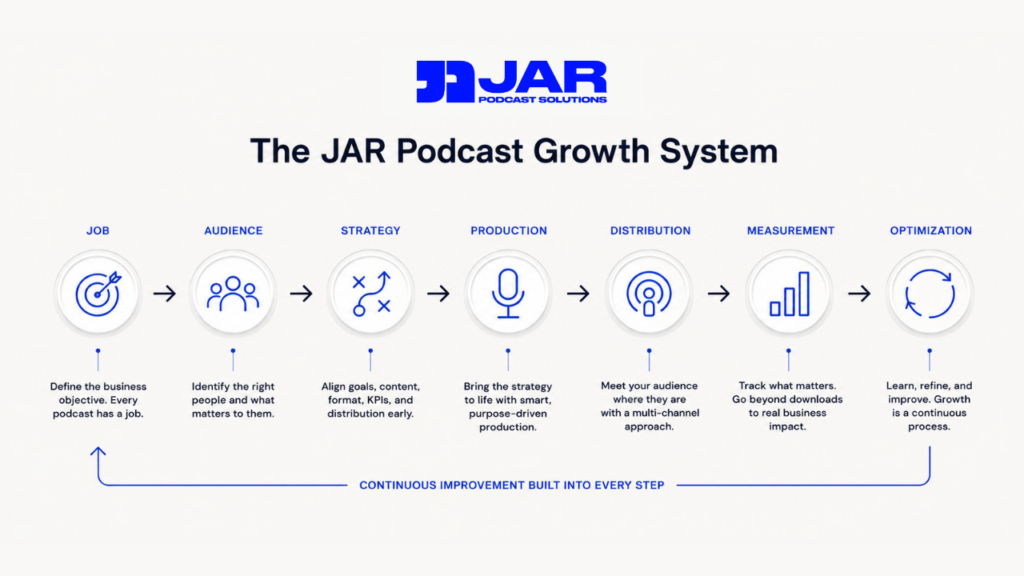
Each stage informs the next.
The job defines the audience.
The audience shapes the creative and distribution strategy.
The strategy guides production.
Production creates material designed to travel.
Distribution connects the podcast with the intended audience.
Measurement reveals what is working.
Optimization improves the next episode, campaign, or season.
Growth is built throughout the whole system. It’s not a checklist added at the end.
Before you launch another podcast
Before choosing a host, booking a studio, writing a script, or creating a production schedule, ask:
- What job is this podcast being hired to do?
- Who needs to hear it?
- Why would they choose to spend time with it (over other media)?
- How will they discover it?
- What will success look like?
- What will we learn after launch?
- How will those lessons shape what comes next?
The earlier these questions are answered, the stronger the show will be.
And who knows, Marge may even put it in the company newsletter.
Take a strategic look at your content ecosystem
At JAR, we’ve deployed this system for years now, and our branded shows routinely chart, win awards, and most importantly – they reach the people they were designed to reach.
If this interests you, JAR’s Expertise Audit examines how your existing content, internal expertise, audience goals, distribution channels, and measurement systems fit together. It is a strategic review of where your strongest opportunities may lie, what may be limiting growth, and how a podcast or other expert-led content could support a larger business objective.
Reach out to us to book it
The conversation starts with the job the content needs to do.
The microphones can wait.