


Here’s what podcast marketers can learn about audience psychology.
I recently traveled to my niece’s fabulously exotic destination wedding — in Edmonton. (Look, say what you will, they know how to throw a party.)
Our whole clan was bunked at a Days Inn where the lobby had a striking abstract mural made entirely of real moss. Given that Moss is my last name, I felt a special connection.
But next to it? Not one, but three signs commanding:
“PLEASE DO NOT TOUCH THE MOSS.”
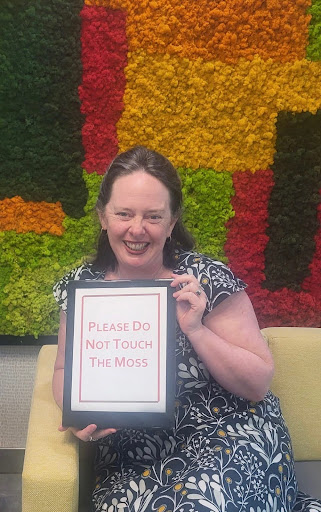
Naturally, my first instinct was to touch it.
That’s not just me being difficult — it’s a textbook case of psychological reactance in marketing.
What is reactance? And why should podcast marketers care?
Reactance is the human impulse to resist when we feel our freedom is being restricted.
Tell people “don’t,” and many will want to do exactly that.
This concept is well-researched (Brehm, 1966). It explains why forbidden things feel more enticing, and why people resist being ordered around.
That hotel sign wasn’t protecting the art so much as daring everyone to defy it.
A smarter approach might have read:
“Everyone wants to touch this moss (understandably). The artist [Name] kindly asks you to refrain so all can enjoy it. Curious about the art of moss mural-making? Learn more at XYZ.”
Instead of scolding, it acknowledges your curiosity and turns you into an ally.
The same principle applies to podcast marketing strategy
Plenty of branded podcasts make the same mistake as the stern lobby sign:
- They lecture instead of inviting.
- They deliver “how-to” lists nobody asked for.
- They squash curiosity with corporate speak.
If someone clicks on your podcast because the title intrigued them, reward that interest.
Great storytelling for branded podcasts doesn’t kill curiosity. It feeds it.
But here’s the twist: You can use reactance on purpose
Reactance isn’t always a trap to avoid. Used deliberately, it’s also one of storytelling’s oldest tricks.
By inviting rebellion or playfully challenging your audience, you can make them lean in further.
- You create intrigue.
- You position yourself as subversive or bold.
- You make listener engagement irresistible — if you pay it off with substance.
Examples of titles that leverage reactance
- Don’t Read This Book: Time Management for Creative People (Donald Roos) – a sly invitation for resistant creatives.
- Do Not Open This Book (Andy Lee) – a bestselling kids’ series built on reverse psychology.
- Don’t Push the Button! (Bill Cotter) – an interactive children’s hit that practically begs kids to break the rule.
- Don’t Make Me Think (Steve Krug) – a UX design classic that promises simplicity by acknowledging reader resistance.
- Don’t Let the Pigeon Drive the Bus! (Mo Willems) – an award-winning picture book that turns rule-breaking into participatory fun.
- Steal This Book (Abbie Hoffman) – the counterculture classic that dares you to transgress. Try NOT at least picking up a book that is begging you to steal it.
These titles don’t shut you down — they invite you in by deliberately stoking curiosity.
The rule: Use reactance consciously
This is the critical difference:
- Accidental reactance happens when you scold, lecture, patronize, oversimplify, or deliver disappointing content. You lose trust.
- Deliberate reactance is when you play with resistance as a hook, knowing your audience, and ensuring you deliver value on the other side.
It’s not about always avoiding “don’t.” It’s about knowing when to use it — and how.
How podcasters can apply this to content planning
Don’t flatten curiosity with sterile summaries
Summaries are great for SEO — but less great for audiences with busy lives. If they just wanted a summary, they’d skip the podcast and read the Coles Notes. (Incidentally – if you are reading this summary but skipped the article, you may want to re-evaluate your lifestyle just a tad. Maybe go touch some moss.)
Don’t bait with a provocative title only to underdeliver with a sales pitch
If you promise earth-shattering revelations, make sure what you deliver actually cracks something open for the listener — whether that’s a new idea, an unexpected truth, or a deeper understanding.
If you’re going to challenge, tempt, or dare the listener, make sure you reward their leap of interest. This is essential to how to grow your podcast audience in a way that builds loyalty and trust.
Four podcasts that reward curiosity
1. Song Exploder (Radiotopia)
Like Hoffman’s Steal This Book, Song Exploder dares listeners to “blow up” their favorite songs. But by dissecting them, it delivers a deeper appreciation for how the songs are crafted, rewarding curiosity with insight into the creative process.
2. Nice Genes! (Genome BC / produced by JAR Audio)
Nice Genes! channels listeners’ natural curiosity about genetics — often seen as too complex. Instead of simply presenting facts, it anticipates skepticism or overwhelm and counters it with accessible storytelling, ethical questions, and real-world mysteries. The result is an engaging journey that rewards curiosity with human-centered insights.
3. Sea of Lies (CBC / Uncover)
Sea of Lies builds its whole investigation around resistance. Host Sam Mullins reopens a case locals want closed, challenges an official ruling, and engages reluctant sources. Each “don’t” fuels the inquiry, inviting listeners to follow the evolving con across continents and rewarding their curiosity with new revelations and personal stakes.
4. The Retrievals (Serial Productions & The New York Times)
The Retrievals uses reactance by challenging acceptance of a painful status quo. Instead of a simple exposé, it centers women’s own words to confront the medical system’s minimization of their pain. It offers space and evidence for listeners to question systems and engage actively with uncomfortable truths.
Key takeaways for podcasters and marketers
If you’re lucky enough to earn a listener’s click, don’t squander it.
- Avoid unintentional scolding or patronizing.
- Use reactance and provocation carefully, on purpose.
- Acknowledge the audience’s curiosity.
- Invite them on a meaningful journey.
- Make sure you deliver.
Whether you’re setting real boundaries or implicitly daring your audience to cross them, the real skill lies in understanding when each approach will engage them best.