
Podcasts are seductive.
Find a smart host, book some interesting guests, buy a microphone, and suddenly your company has a show.
But there’s a more important question to answer first:
Should your company be making a podcast at all?
The short answer
A company should start a podcast when it has a specific job for the show to do, a clearly defined audience with a reason to listen, enough original material to sustain a series, a realistic distribution plan, and a measurable business result.
If you can’t answer those questions yet, you probably don’t need microphones. You need a strategy.
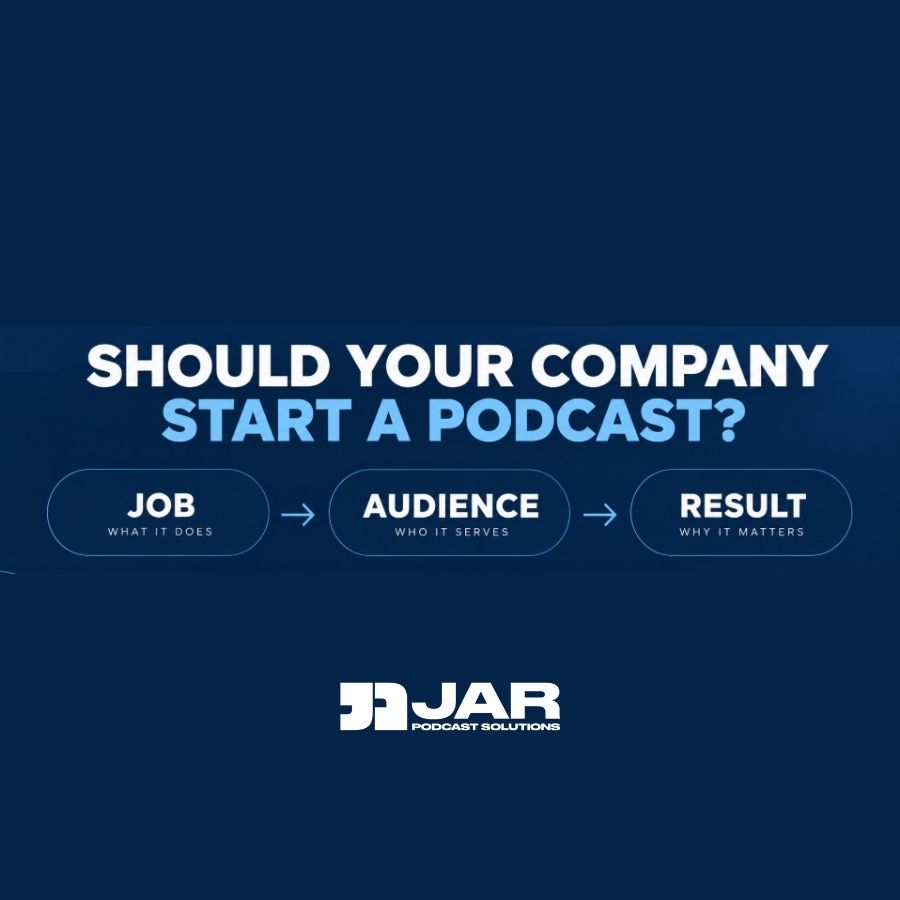
At JAR Podcast Solutions, we start with three things:
Job. Audience. Result.
That’s the foundation of the JAR System.
Before you think about cameras, celebrity guests or what the cover art might look like, start there.
JOB
1. What business job does the podcast need to do?
A podcast is a format. It isn’t a business objective.
“Thought leadership” isn’t much of a job either. Neither is “brand awareness.”
Ask instead:
What needs to happen because this podcast exists?
For Amazon’s This Is Small Business, the job was to help entrepreneurs build stronger businesses through practical stories and lessons from people who had already done it.
For Genome BC’s Nice Genes!, the challenge was completely different: make complex genomics interesting and accessible to a younger, science-curious audience.
For Where AI Works, created with the Wharton School and Accenture, the job was to take academic research about AI and connect it to the actual decisions business leaders are making.
Same medium. Three very different jobs.
A branded podcast might need to:
- Build authority around a complicated subject
- Reach a difficult-to-access professional audience
- Help customers better understand a category
- Create stronger relationships with a community
- Give executives a platform for substantive ideas
- Turn proprietary research or expertise into useful media
- Support a broader content marketing strategy
If you can’t explain the job of your proposed podcast in one sentence, don’t start recording yet.
2. Is a podcast actually the right format?
Sometimes the answer is no.
If your idea depends on showing people something, video may need to lead.
If your audience wants quick, practical answers, a newsletter or searchable resource may work better.
If you only have three good stories to tell, you may have a campaign rather than a podcast.
Podcasting is particularly good at conversation, personality, complexity, story and sustained attention. It gives brands room to explore ideas that are hard to squeeze into a LinkedIn post or 90-second video.
And one recording can often do several jobs.
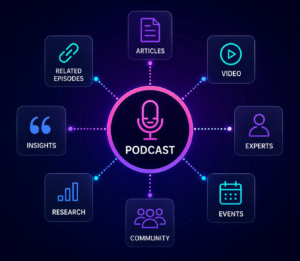
A video podcast can become a YouTube episode, an audio episode, LinkedIn clips, short-form video and other platform-specific content.
The question isn’t “Should we have a podcast?”
It’s:
Does podcasting help us accomplish the job better than another format would?
AUDIENCE
3. Who is the podcast for, and why would they listen?
“Business leaders” is not an audience.
Neither is “people interested in innovation.”
Get more specific.
CFOs at mid-market technology companies dealing with AI investment decisions? Better.
Independent restaurant owners trying to grow beyond one location? Better.
Healthcare leaders responsible for implementing new technology across hospital systems? Now there’s something to work with.
Then ask the slightly uncomfortable question:
Why would these people give you 30 or 40 minutes of their lives?
Your audience already has Netflix, YouTube, books, newsletters, other podcasts, friends, children, dogs and an alarming number of notifications.
Your company is not automatically entitled to their attention.
A strong company podcast gives people something worthwhile in return: useful information, unusual access, expertise, entertainment, great stories, original reporting, or a host they genuinely enjoy spending time with.
That’s the deal.
4. Does your company have something people can’t easily get elsewhere?
This is becoming more important as AI makes commodity information easier to summarize.
If your show consists of people having reasonably intelligent conversations about familiar ideas, the useful bits can increasingly be extracted without anyone listening to the episode.
So what makes the actual experience worth having?
It might be:
- Access to people others can’t easily reach
- Proprietary research or data
- Original reporting
- A remarkable archive
- A community with interesting stories
- Deep subject-matter expertise
- Strong storytelling
- A distinctive host or point of view
Your advantage does not have to be a giant research department.
Sometimes it’s simply having access to the right people and knowing what questions to ask them.
But there needs to be something there.
The stronger and more original your source material is, the harder your podcast is to replace with a summary.
5. Do you have enough ideas to sustain a podcast series?
Before approving a new branded podcast, come up with 15 episode ideas.
Seriously.
Don’t worry about titles yet. Just prove the territory exists.
If episode seven starts looking suspiciously like episode three, you may have a campaign idea rather than a podcast.
Strong shows have an editorial engine: a question, community, area of expertise, field of research, storytelling device, or continuing source of tension that keeps generating new material.
You want a subject that keeps opening doors rather than slowly running out of hallway.
DISTRIBUTION
6. How will people discover the podcast?
Publishing a podcast is not a distribution strategy.
Neither is posting “Episode 1 is live!” on LinkedIn.
Before launch, know where your audience already spends time and how you intend to reach them there.
That could include:
- YouTube
- Spotify and Apple Podcasts
- Company newsletters
- Paid media
- Guest networks
- Cross-promotion with other shows
- Earned media and PR
- Industry partnerships
- Conferences and events
- Internal communications
- Sales and customer-success channels
RBC’s Disruptors, for example, combined stronger editorial development with a deliberate growth plan that included cross-promotion, paid placements, LinkedIn, earned media and Apple Podcasts pitching.
The exact mix will depend on the audience.
But it needs to exist before launch.
A brilliant podcast nobody discovers is still a podcast nobody discovers.
RESULT
7. How will you know if the company podcast worked?
Downloads are useful.
They are not universally the point.
For a large public-facing show, audience growth, watch time, completion and subscriber growth may be important.
Another podcast might be designed for a much smaller group of executives, researchers, employees or customers.
In that case, 10,000 random listeners could be less valuable than 500 of exactly the right people.
Ask:
What should change if this podcast succeeds?
Depending on the job, that might include:
- Audience growth
- Listener or viewer retention
- Subscriber growth
- Qualified leads
- Brand consideration
- Employee engagement
- Event registrations
- Executive visibility
- Sales enablement
- Content engagement
- Relationships with a specific community
The right podcast metrics depend on the job the show was created to do.
That’s why measurement should be designed before production starts, not bolted on six months later.
When should a company NOT start a podcast?
A company probably shouldn’t start a podcast yet if:
- Nobody can clearly explain its business purpose
- The intended audience is vague
- The concept depends entirely on getting famous guests
- There aren’t enough strong episode ideas for a series
- The content sounds like information already available everywhere else
- Nobody owns audience growth
- There’s no realistic distribution budget or plan
- Success will be judged entirely on download numbers
- The company isn’t prepared to commit enough time to make the show good
None of those problems necessarily kill the idea.
They simply mean the strategy needs more work before production begins.
Branded podcast readiness checklist
Before you greenlight a company podcast, you should be able to answer three big questions:
Job: What does this podcast need to do?
Audience: Who is it for, and why will they care?
Result: What will tell you it was worth doing?
Then pressure-test the idea:
Format: Is podcasting actually the best way to accomplish the job?
Originality: What can we give the audience that they can’t easily get elsewhere?
Editorial engine: Can we generate at least 15 strong episode ideas?
Distribution: How will the right audience discover the show?
If you have good answers to those questions, you may have the beginnings of a strong branded podcast.
If not, that’s useful information too.
Want to know if your company is ready for a podcast?
We’ve turned these questions, plus a few of the harder ones in between, into a simple Branded Podcast Preparedness Worksheet.
It’s designed to help you figure out whether you have the beginnings of a strong podcast, where the gaps are, and what you should sort out before anyone starts booking guests or buying microphones.
If you’re considering a new show, contact JAR Podcast Solutions and ask for the worksheet. We’ll send you a free copy.
Because the best time to discover your podcast doesn’t yet have a reason to exist is before you make twelve episodes of it.
At JAR, that’s why we start with Job, Audience, Result.
The microphones come later.