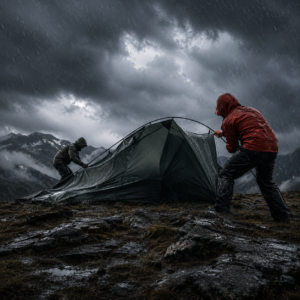


They say that resilience is knowing when you are down and doing something about it.
It is an understatement to say that everyone’s resilience is being tested right now. And when resilience is tested we look for communities and leaders to make sense of the noise to help us get through it. But not all communities or leaders will stand up.
It feels to me like a watershed moment. Some have joked that Climate Change needs to have COVID-19’s PR agent. I’d argue that COVID-19 is the lens under which everything changes. One cannot wear COVID-19 glasses without forever seeing our society and the earth differently. And that lens is community and leadership.
People have been looking at political leaders and corporate leaders to make difficult decisions. Closing schools. Closing down the NBA. Closing Apple stores. Closing restaurants. Flattening the curve to keep our hospitals from being overwhelmed. Opening and closing borders and ports. Maintaining our food supply. It is taking more than a village. It is taking a strong community around the world. Everyone is in this.
So, what is the role of the marketer and the communicator? There has never been a greater need for information. In fact, the internet has been spiking in multiple jurisdictions as COVID-19 expands. The demand for information is going up. Yet not all communications professionals will step up to meet this demand.
Marketers and communications professionals spend on average a few years of their careers at each employer. Overall, the largest brands survive on the S&P 500 for an average life of only 18 years (down from 61 years in 1958). McKinsey Consulting believes that by 2027, 75% of the companies currently quoted on the S&P 500 will be gone. So, if a communications professional lasts for a few years, and the lifespan of the company independently and publicly lasts 18 years, this means there will be on average 6 communications professionals in each public company in total.
Which of those pros will experience a boom? Which will experience a bust? And which will live through a pandemic? The odds of the former I’d guess are half. The odds of the latter are 1, or none.
That’s why this really is a watershed career moment for you. This is the time where citizens are looking to you for leadership, for information.
What are you going to do about it?
The simplest thing to do would be to write a news release. I’ve seen a number of these. Cold, calculated and written by committee. They spell out the legality of the COVID-19 measures being taken. They may present aspirational statements about taking care of employees and the public. But between the lines, I don’t hear any humanity. It’s hard to be completely authentic with text. Fonts don’t convey empathy the way human voices intonate to share compassion.
I don’t know the science of completion rates of press statements. I’m sure there is a social-ROI calculation for them somewhere. But that doesn’t solve the opportunity of humans needing communities and leadership direction to feel confident. To know that one day soon this will end. That we will be okay. As my children say to me when they are overwhelmed: I need a hug.
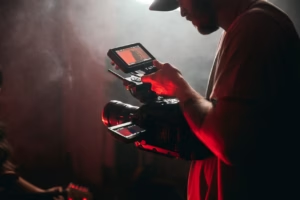
I encourage every brand to consider producing a podcast, right now. Today.
As a citizen in Vancouver, BC, personally I need to need to hear Justin Trudeau’s voice right now and that of my Mayor Kennedy Stewart. I need to hear the voice of Dr. Theresa Tam and Dr. Bonnie Henry. And as a consumer, I need to hear Tim Cook’s voice from Apple today. And Yvon Chouinard’s (Patagonia). And Calin Rovinescu (Air Canada). Also, Ed Sims (WestJet). And Calvin McDonald’s (Lululemon), Galen Weston (Loblaw), Phillip Crawley (Globe and Mail), Mark Thompson (New York Times), Elon Musk (Tesla), Roger Dall’Antonia (Fortis BC), Chris O’Riley (BC Hydro), Tamara Vrooman (Vancity), David McKay (RBC) and David Suzuki (DSF). I could go on and on. And I’d listen to 90%+ of each podcast. Not just because of the moment, we are in, but because that is the engagement rate we experience at our company, JAR Audio, every day.
I want crucial information now from our corporate community leaders and I want to hear it from their own voice.
And it is simple and affordable to do. High-quality podcasts can be recorded and mixed remotely with ease. They’re a proven way to connect people while maintaining “appropriate social distance.”
So, if you are a courageous communicator — and recognize that the time for you to stand up is now, contact us today, and let’s get started. We have an audience waiting to hear desperately from you.
Paul Stewart is the Director of Outreach at JAR Audio