
with Steve Pratt, Author of the hit book Earn It
CASE STUDY

Company size
Website
The pandemic changed where millions of people worked almost overnight.
By 2023, hybrid work was no longer just a temporary response to an extraordinary situation. For many organizations, it had become an ongoing operational challenge.
IT leaders were being asked to support distributed teams, modernize workplace technology and improve employee experiences.
Operations executives needed to balance productivity, collaboration, security and organizational culture.
And everyone had an opinion about what the future of work should look like.
What was harder to find was practical guidance.
Companies had access to an expanding collection of collaboration platforms, automation tools, analytics systems and digital workplace technologies.
But adding more technology didn’t automatically create a better employee experience.
How should organizations measure whether hybrid work was effective?
What role should IT play in employee satisfaction?
How could leaders understand the relationship between workplace experience and business performance?
And which investments were making things better rather than more complicated?
These were questions with real consequences for enterprise organizations.
Kyndryl helps large organizations design, manage and modernize complex technology environments.
IDC brings research and analysis of the technology and business challenges facing enterprise decision-makers.
Together, they had the knowledge to contribute something useful to the hybrid-work conversation.
But another podcast featuring broad predictions about the future of work wasn’t going to be enough.
Their audience already knew hybrid work was important.
They needed help understanding what to do about it.
The opportunity was to turn research and experience into concise conversations for IT leaders, chief operating officers and other executives responsible for building effective workplaces.
That became the job of Making Hybrid Work.
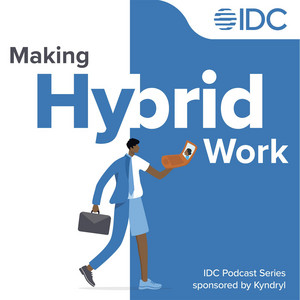
JAR worked with Kyndryl and IDC to create Making Hybrid Work, a three-part audio podcast exploring the practical challenges of distributed work.
Rather than trying to cover every aspect of hybrid work, we organized the series around three connected questions.
What makes a good employee experience?
How do you measure whether it’s working?
And how do technology, leadership and workplace design come together to improve it?
This gave the series a clear editorial direction.
Each episode had a distinct purpose, while contributing to a larger conversation about the future of enterprise work.
The first episode explored a problem that can get lost in conversations about enterprise technology.
People are the ones using the systems.
IDC’s Matt Eastwood and Amy Loomis spoke with Kyndryl’s Sarah B. Nelson, Chief Design Officer and Distinguished Designer, about building hybrid workplaces around human needs.
The conversation examined how design, technology and organizational decisions influence the employee experience.
It established a useful starting point for the series: before choosing another tool, understand the people it’s supposed to help.
The second episode focused on measurement.
IDC’s hosts were joined by Ron Xavier, Microsoft’s Center of Excellence Leader at Kyndryl Digital Workplace Services.
They explored how organizations can evaluate employee experience and whether their technology investments are improving working conditions.
One important question was whether adding more workplace tools actually makes employees more productive.
The discussion challenged the assumption that more technology necessarily creates a better workplace.
For IT leaders responsible for large technology environments, that was a practical question worth examining.
The final episode brought the different parts of the problem together.
Matt Eastwood and Amy Loomis spoke with Dennis Perpetua, Chief Technology Officer for Kyndryl’s Digital Workplace Global Practice.
The conversation explored how organizations can evaluate employee experiences holistically, the obstacles to improving hybrid work and the relationship between employee and customer experience.
It gave the series a useful conclusion.
Creating an effective hybrid workplace requires more than individual technology decisions. It involves understanding how systems, people and business objectives interact.
The combination of IDC and Kyndryl was central to the editorial approach.
IDC contributed research and an independent industry perspective.
Kyndryl contributed experience working inside complex enterprise technology environments.
JAR’s role was to turn those perspectives into structured, accessible conversations.
We focused on questions that mattered to the audience, helped prepare contributors and developed episodes that moved beyond general commentary toward practical insights.
The show wasn’t built around Kyndryl talking about its services.
It was built around problems its audience was trying to solve.
That’s the distinction we explore in What Are Good Goals for a B2B Podcast?.
We used the JAR System to connect the show’s business objective, editorial direction and performance measures.
The Job
Help Kyndryl establish a useful thought leadership platform around enterprise hybrid work, connecting its technical expertise to the decisions facing business leaders.
The Audience
IT executives, chief operating officers, workplace technology leaders and other senior decision-makers responsible for employee experience and distributed work.
The Result
Create a focused series that attracted relevant listening activity and maintained attention through useful, expert-led conversations.
These decisions informed the episode structure, guest preparation, production and measurement.
Rather than producing an ongoing series without a defined editorial scope, the partners created three episodes addressing three specific challenges.
JAR supported the project across:
The result was a limited series with a clear editorial beginning, middle and end.
Not every branded podcast needs dozens of episodes.
Sometimes the better decision is to identify three questions your audience genuinely needs answered and give each one the attention it deserves.
Making Hybrid Work demonstrated that a short, focused B2B podcast could sustain meaningful audience attention.
The series achieved 84% average episode consumption on Apple Podcasts.
Listeners also spent more than 70 hours with the content on that platform.
Those results matter because the podcast wasn’t designed as general entertainment.
It was created for enterprise decision-makers interested in practical challenges around hybrid work, employee experience and technology.
The reported listening data showed that people accessing the episodes were spending substantial time with the conversations.
Listeners consumed an average of 84% of episode content on Apple Podcasts.
For a series featuring conversations lasting approximately 30 to 40 minutes, that’s evidence of sustained attention.
The editorial approach gave each episode a clear question to explore.
Rather than attempting to cover hybrid work in general, the series addressed specific concerns facing enterprise leaders.
The first episode explored human-centred workplace design.
The second focused on technology and employee experience measurement.
The third brought those questions together through a discussion of how organizations can evaluate and improve their hybrid environments.
This structure provided a practical reason for listeners to stay with each conversation.
An 84% average consumption rate doesn’t establish that listeners acted on the advice. But it does demonstrate meaningful engagement with the content.
The series generated more than 70 hours of total listening time on Apple Podcasts during the reported period.
For a three-episode podcast, that provides another useful perspective on engagement.
Instead of evaluating the project only by the number of downloads, total listening time shows how much attention audiences devoted to the content.
The figure represents Apple Podcasts listening, not necessarily all listening across every distribution platform.
It also shouldn’t be mistaken for unique audience reach.
What it does establish is that the series generated measurable time spent with Kyndryl and IDC’s expertise.
Making Hybrid Work was deliberately developed as a limited series.
That gave the editorial team an opportunity to focus on three related problems rather than stretch the subject into an ongoing program without a clear purpose.
Each episode combined industry research with technical expertise.
Together, the conversations addressed the human, operational and measurement challenges of hybrid work.
The format also created a reusable collection of expert perspectives that could remain relevant to audiences exploring workplace transformation beyond the original launch.
B2B podcasts are often created for relatively small, specialized audiences.
A series aimed at enterprise IT leaders shouldn’t necessarily be evaluated against the same audience expectations as a general entertainment podcast.
Audience size matters, but it isn’t the only useful measure.
The questions are more specific.
Did the content attract people interested in the subject?
Did they spend time with it?
And did the conversations support the organization’s communications objectives?
For Making Hybrid Work, the available data demonstrates meaningful episode consumption and total listening time.
We don’t have verified evidence of the number of target accounts reached, changes in brand perception or commercial opportunities influenced by the series.
Those outcomes would require additional measurement.
But the engagement results provide a useful foundation for evaluating the show’s performance.
The lesson from Making Hybrid Work is that a focused podcast doesn’t need to cover everything.
Kyndryl and IDC could have produced a broad series about the future of work.
Instead, they focused on three questions executives needed answered.
They brought together research and enterprise experience, then used a repeatable editorial approach to explore each subject.
The result was a limited series that maintained an average of 84% episode consumption.
For technology companies trying to make complicated subjects accessible, that approach is worth considering.
Start with the decisions your audience faces.
Bring in experts who can help explain those decisions.
Build episodes around specific questions.
Then use podcast analytics and measurement to understand whether people are spending time with the work.
To see another example of a podcast built for a defined B2B audience, explore JAR’s Port of Vancouver case study.
Have a complex technology story worth telling?
JAR Podcast Solutions helps B2B organizations develop, produce and measure podcasts that connect expertise to audience needs.
Making Hybrid Work is a three-episode podcast created by Kyndryl and IDC, with production support from JAR Podcast Solutions. Released in 2023, it explores the human, technological and operational challenges of hybrid workplaces through conversations with IDC researchers and Kyndryl experts.
The series achieved 84% average episode consumption and generated more than 70 hours of listening on Apple Podcasts during the reported measurement period. These metrics demonstrate listening engagement but do not independently establish brand lift, target-account reach or commercial ROI.
Yes. A limited series can be useful when it addresses a clearly defined audience need. Making Hybrid Work focused on three connected subjects: human-centred workplace design, measuring employee experience and improving hybrid work environments. Its 84% average consumption rate demonstrates meaningful attention to the content.
IDC contributed research and industry analysis, while Kyndryl brought enterprise technology expertise. The combination allowed the show to explore workplace challenges through complementary perspectives rather than focusing only on one company’s services.
A strong enterprise technology podcast addresses specific business and operational decisions. It connects expert knowledge to recognizable challenges, avoids unnecessary product promotion and gives listeners practical insight. Making Hybrid Work explored employee experience, workplace technology and measurement through conversations relevant to enterprise leaders.
Start with the podcast’s objective and intended audience. Useful measures include unique listeners, target-account reach, episode consumption, total listening time, follower growth and qualified engagement. For Making Hybrid Work, JAR reported 84% average episode consumption and more than 70 hours of Apple Podcasts listening. Additional audience and business data would be needed to assess commercial impact.
Listeners consumed an average of 84% of episode content on Apple Podcasts, demonstrating sustained attention to conversations about hybrid work and enterprise technology.
The series generated more than 70 hours of listening on Apple Podcasts, providing a measure of audience attention beyond download counts.
The limited series brought IDC research and Kyndryl expertise together around three workplace challenges: human-centred design, employee experience measurement and effective hybrid operations.