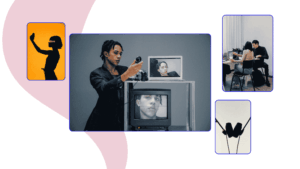


Audio podcasting is invisible filmmaking — every sonic choice is a brushstroke. Without intent, your listeners get lost in a fog of words. That’s why smart audio storytelling techniques matter: you shouldn’t just hear a scene; you should see it. Central to this is sound design — woven seamlessly into your narrative. Do it wrong, and you’ll confuse listeners or “over‑manipulate” their emotions, pulling them out of the story.
Getting good at audio editing and sound design is a lifelong pursuit, but luckily, there are some basic principles that anyone can keep in mind, and that can drastically improve your audio podcast. From dialogue editing and pacing to ambient noise, vocal delivery, and action cues, each sonic element layers crucial information — location, mood, tension, clarity — into your story.
1. Capture wild sound from the outset
- Always record 10–15 seconds of room tone and ambient sound before — and after — each take.
- Drop that wild track under your dialogue or SFX to smooth edits, fill gaps, and maintain a consistent background texture. Easy peasy.
2. Dialogue editing: Carving out clarity & tension
- Before: Tangents, filler words, jargon — your listener hears noise, not narrative.
- After: Let your lines breathe — don’t cut natural breaths or pauses. Each trim hones the story’s spine, highlights conflict, and keeps it simple so listeners never ask, “Wait, what just happened?”
Tip: Silence is as powerful as sound. Use it to punctuate big moments.
3. Pacing: The rhythm of emotion
- Fast cuts for urgency and excitement.
- Measured beats for reflection and intimacy.
- Transitional sounds — a quick whoosh or subtle drone — signal shifts in mood or pace without a word.
- Example: A low‑pass filtered whoosh can cue a flashback; a rising drone ushers in a tense reveal.
- Lab‑Tour Case Study: In a recent lab‑tour episode, we used the click of a microscope turret plus a filtered electronic tone to slide listeners from casual chatter into a high‑stakes experiment.
By controlling pace, you sculpt tension and release — vital tools for holding attention — while keeping clarity so listeners aren’t overwhelmed.
4. Ambient noise & location: Anchoring the scene
- Distant chatter and seagulls drop you onto a crowded boardwalk or windswept pier.
- Street hum, HVAC whirr, faint café clink: instantly place your audience in a café, corridor, or rooftop.
This is the heart of branded podcast creative direction: choosing background layers that mirror your brand world and invite listeners to step inside. Be guided by the needs of your narrative. Recording on a beach or rooftop makes sense only if the location serves your story; always be intentional.
4. Vocal delivery: The human lens
- Monotone or forced AI jollity — bad attempts to sound “casual” — tune listeners out.
- Dynamic performance — pauses, whispers, breaths — guides attention and conveys authenticity.
Professional voice actors excel at delivering tailored “reads” for every moment — one clear advantage of trained talent. But if your host’s energy feels entirely natural, that works just as well. With a skilled studio director, you can coax out a nuanced performance that becomes a beacon, guiding your audience’s attention exactly where you want it.
5. Action cues & foley touches: Cementing the moment
- Foley touches help cement the listener’s ability to picture the action within a scene: engine driving awar, a fist meeting flesh, the clink of climbing gear.
- Balance your sound layers so each is audible without masking the others. Avoid the rookie mistake of making your foley too loud.
- The sound of action can get confusing and chaotic in audio – which can cause listeners to “drop out,” so sometimes you need to anchor your action soundscape with a bit of well-placed dialogue to reinforce details.
Mid‑action dialogue examples:
(SFX: bus pulls away)
“Hey! Wait for me!”
(SFX: lands a punch)
“Oof. That all you got?”
(SFX: gravel falling, clink of climbing gear)
“How high is this cliff?”
Keep these dialogue assists simple and sparing — just enough to ground the listener without pulling them out of the moment.
Painting with sound layers
Sound is a palette, and you can use it to “paint” a scene. How do you do this? It’s a highly instinctive, creative process – but try thinking about:
- Sketching in the location details: Are you in an open market in Tangiers? Take us there. A crowded symphony? Let’s hear the woman behind you cough. Is the space big or small, hard or soft, smooth & echoey or carpeted? Convey this through ambient tone and reverb. Think of sound as 3-dimensional character in your story.
- Mood as sound watercolour wash: Warm reverb for nostalgia; distant drone for unease; rain taps for melancholy, and so on. One interesting thing is that you do not need to be overly literal here. A character may tell a sad or nostalgic story against the sound of a moving train… it doesn’t have to be violins. In fact – best to avoid sonic cliche, and do what feels most real to you.
- Tension line drawings: Use tension tracks to build suspense and faster‑paced music to indicate a complex process or a long journey. Think of these as lines that run through your scenes, drawing the emotional tension like an electrocardiogram.
- Mid-action speech bubbles: “Kapow!” This relates to those crisp Foley cues plus mid‑action dialogue hints that can draw listeners into the action of a scene, clarifying it for them – rather than leaving them adrift and unsure what to picture.
Together, these painterly approaches to sound can form a key part of your podcast engagement strategy — because people most remember the stories they’ve “seen” with their ears.
Summary
By capturing wild tracks, mastering dialogue editing and pacing, distinguishing ambient noise from Foley, refining vocal delivery, treating sound design like painting, and anchoring action with cues — all while balancing levels — you’ll guide listeners through a vivid, memorable journey every time.
Question for you:
- Which sound techniques do you use to enhance your storytelling? Let us know — we’d love to compare notes and ideas!