
Exploring the connection between podcasting and walking.
You know the ancient Chinese proverb, “A journey of a thousand miles begins with a single step”?
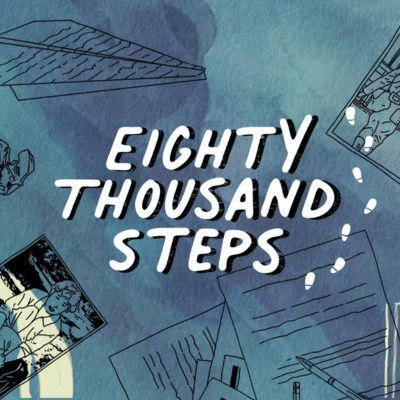
Well, that’s exactly how Crystal Chan’s new podcast, EIGHTY THOUSAND STEPS, kicks off. It’s a podcast app that only works while you’re walking. You can turn this feature off if you have mobility challenges, but in its primary mode of operation, the podcast is powered by your steps. If you sit down, the story stops playing.
So why would someone do this?
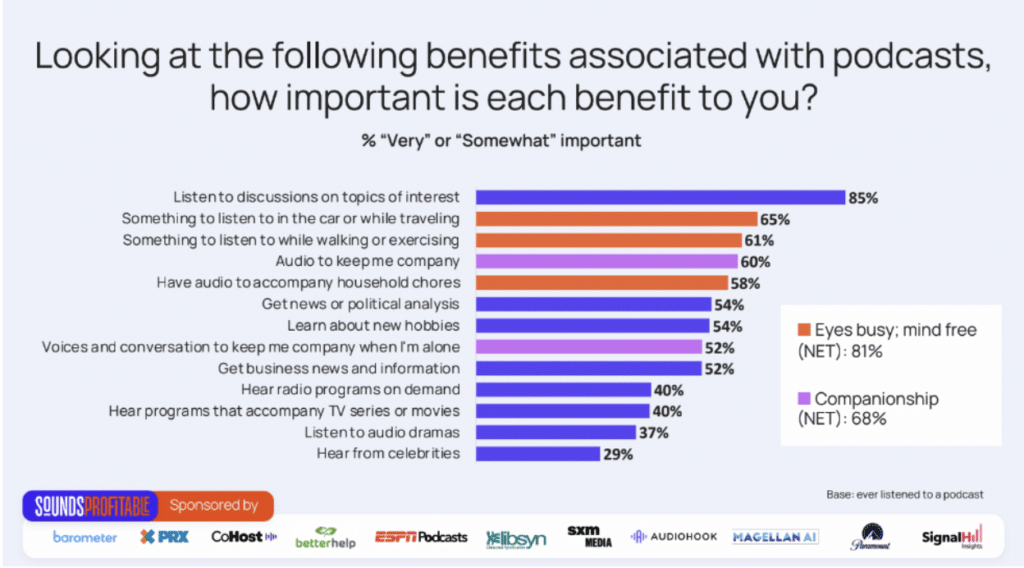
The answer is complex, but it gets at the heart of what makes podcasting so great: its mobility. Every medium has its strengths, and one of the main strengths of audio podcasting is the fact that you can take it with you as you’re walking the dog, commuting across town, or vacuuming the living room. You can enhance and augment these experiences with conversations, learning, and stories in a way that feels somatically grounded. Listening to a podcast while you go about the business of life creates a feeling of mental and emotional space — rather than crowding. In our overly screen-tethered world, people warm to the medium of audio podcasting for these reasons.
What does this mean for brands and podcasts?
This “walking-listening connection” has broad implications for brands.
If you’re a brand thinking of jumping into podcasting, it’s worth noting that audio podcasting presents an opportunity to enter not only the “headspace” but also the physicality of your audience. If you embrace the idea of a story designed to be told while on the move — and you use that platform wisely — you can become part of the muscle memory of all those who listen. Talk about building trust and affinity with your customers!
Check out the top reasons why people love podcasts. Most of them have to do with walking!
Ok – so how does it work?
It turns out that there is something about the actual act of walking that makes us more receptive, more creative, and more able to remember things. Think about it: Many of us have our best ideas while walking. Steve Jobs expounded the virtues of walking meetings. William Wordsworth’s rambles led to bursts of creativity. In fact, this insight is over 2000 years old — and was already known to the philosophers in ancient Greece. Aristotle himself preferred to lecture on the move, and it was Hippocrates who once said,
“If you are in a bad mood, go for a walk. If you are still in a bad mood, go for another walk.”
In a more recent study, behavioral scientists Marily Oppezzo and Daniel L. Schwartz out of Stanford University found that walking outside has a profound influence on your creativity; even more than other forms of activity. In the first part of their experiment, adults completed something called “Guilford’s alternate uses (GAU) test of creative divergent thinking” while seated, and then when walking on a treadmill. Walking increased 81% of participants’ creativity on this test. 81%! They also tested the effect of walking on the participants’ “creative analogy generation” — another sure sign of creative thinking. Participants sat inside, walked on a treadmill inside, walked outside, or were rolled outside in a wheelchair. Walking outside produced the most novel and highest-quality analogies.

Crystal Chan’s piece takes this idea several ‘steps’ (pun intended) further and embraces the theme of walking within the actual storyline itself.
Part memoir, part imaginative fiction, the podcast describes Crystal’s grandmother’s journey out of war-torn China in 1938. As a small child, her grandmother was forced to join thousands of refugees on the road on a long march out of Guǎngzhōu, which was under attack by the Japanese. As we listen to the tale, we must physically walk to keep the story moving. This draws us closer to the main character in a way that transcends words and brings an added dimension to the story as we think about what it would have felt like to walk so far, under such duress, at such a young age. Chan also describes how her grandmother — who eventually relocated to Vancouver BC — used to tell her fantastical stories as a child, but only if she kept up while walking. In the podcast, walking becomes a metaphor for storytelling and a sign of love. It helps us empathize with the main characters.
The connection between walking and podcasts
Many brands have begun to explore the connection between walking, listening, and learning.
Hotels, museums, travel brands, and cultural and tourism organizations are among those so far that have created audio podcasts specifically designed to be experienced while walking. These can range from linear, auto-play mode experiences that unfold within a set timeframe, to wholly interactive, connected experiences that the user “unlocks” with sensors or QR codes as they make their way around a particular geographical location. Popular examples from recent years might include Rick Steves’ self-guided audio walking tours, or The Demigods, A Villa Audio Tour from the World of Percy Jackson, an exhibition at the Getty Villa in Malibu, California. Plus, several interesting platforms have popped up that enable you to upload and access geolocated audio walks. We’re even seeing recent experimentation with AI-driven interactive podcasts relying on participant conversations with souped-up chatbots.
All this begs the question:
What could “taking a stroll” in the form of a powerfully affecting, mobile audio podcast do to increase audience receptivity towards your brand?
Mobile audio storytelling is, without a doubt, one of the most potent ways to get your ideas across and ensure that they will be remembered. Why? The bottom line is that walking has a profound effect on the brain’s receptivity to new ideas. As the philosopher Jean-Jacques Rousseau noted, “When I stop, I cease to think; my mind only works with my legs.” Walking helps us see things in a new light. It helps us pay attention better. And, as one of my favorite poets, Mary Oliver — who often walked in nature to inspire her writing — once put it: “Attention is the beginning of devotion.”
The chance to hold attention. The chance to cultivate devotion. These are strong reasons for brands to create content designed to be experienced while on the go.
If you’d like to explore the route with us at JAR — reach out! We’re always game to start a new journey.
By: Jen Moss