
If you spend enough time in the advertising ecosystem, you learn to spot the Trend Cycle.
Every few years, a phrase catches fire. Agencies scramble to form new task forces. Decks get hastily refreshed. Everyone behaves as though they have just discovered fire, language, or the wheel.
This year, commenting on the vibe at Cannes, James Crane, Director of Business Development at Sugar23, a Hollywood entertainment and talent management company that helps brands create premium content, posted to Instagram:
“C-suite content creators are becoming the new influencers.”
It’s a great line. And it’s catching attention because it feels true.
But it is also part of a larger pattern in branded entertainment.
JAR Podcast Studios right now…
Just take a look at where the industry is putting its attention and money:
At Cannes Lions this year, creators were not treated as a side conversation. They were everywhere: in dedicated tracks, brand conversations, and industry coverage. Business Insider reported that creator ad spend in the U.S. is projected to reach $44 billion in 2026, and described creators as having “muscled in” at Cannes.
The IAB’s 2025 Creator Economy Ad Spend & Strategy Report found that U.S. creator-economy ad spend more than doubled from $13.9 billion in 2021 to $29.5 billion in 2024, with IAB projecting $37 billion in 2025. By 2026, Marketing Dive reported that creator marketing was on track to hit $44 billion.
Edelman’s 2026 Trust Barometer points to a world retreating into smaller, more familiar circles of trust. It also found that trusted social voices can help open doors for brands: among people who already trust a food and lifestyle influencer, 62% said they would trust or consider trusting a food company they currently distrusted if that influencer vouched for it.
Creative industry leader David Droga, in an interview on the Wharton/Accenture podcast Where AI Works, argued that while AI may eliminate what he calls the “mediocre middle” of formulaic creative work, it will ultimately make taste, originality, and human judgment more important, not less.
Adweek has pointed to the rise of brand entertainment studios, including Nike’s Waffle Iron Entertainment, LVMH’s 22 Montaigne Entertainment, Dick’s Sporting Goods’ Cookie Jar & A Dream Studios, and Under Armour’s Lab96, as evidence that brands are investing in “owned” media properties, Hollywood-calibre creative quality, and studio infrastructure.
Put together, these signals point in the same direction: Branded entertainment is becoming a strategic priority for companies that want to build long-term audience relationships instead of renting attention.
What’s happening is bigger than creator marketing. It’s the continued rise of branded entertainment as a business strategy. It’s not new. But there a new conversations happening about it.
Whether we are talking about executive creators, brand studios, owned media, creator partnerships, live experiences, or companies building their own entertainment ecosystems, the underlying shift is the same: organizations can no longer assume they are entitled to attention. They have to earn it.
And over the past few years, branded entertainment has emerged as one of the best ways to do that because they create something advertising rarely gets: time, intimacy, trust, and room for complex ideas and stories to unfold.
Almost a decade ago, my friend Steve Pratt and the original team at Pacific Content branded podcast studios were among the first people I heard making this case clearly in the podcast space. They championed what was then still a fairly radical idea: brands needed to stop thinking like traditional advertisers and start earning attention through shows people would actually choose.
As Steve wrote back in 2018: “We needed to create a strategy to help our clients learn to think and act like media companies.”
When JAR Podcast Solutions was born, we paid close attention to that signal.
And then, we expanded on it.
We didn’t want to create shows that were merely “adjacent” to a brand, like a vague content play loosely hovering somewhere near the mission statement. We wanted to create shows that felt as though they came from within the brand’s own ecosystem: shows that pulled back the curtain, and let audiences hear how large organizations actually think, struggle, build, change, tell stories, and communicate. Shows that served the brand’s business goals.
But inside-out does not mean inside-baseball.
We never gave up on the essential duty of any good show: to entertain, inform, and serve an audience.
A branded podcast cannot simply reveal the inner workings of a company and assume people will care. It still has to offer a listener something of value: insight, emotion, humour, practical wisdom, access, surprise, or a better way of understanding the world.
That idea has led to us creating award-winning podcasts like This Is Small Business, hosted by Amazon employee Andrea Marquez, and Infernal Communication, hosted by Staffbase’s then Director of Communications, Kyla Sims.
Both shows came from deep within a brand ecosystem, but neither asked audiences to care simply because the brand cared. They gave listeners a reason to come closer. The Amazon show helps small business owners feel less alone and gives them insight into how to succeed. Staffbase, a digital internal comms platform, deliberately designed a show to feature “the kind of stories comms professionals might tell in the bar, after work.”
That, to me, is where branded podcasting becomes most interesting.
Great branded entertainment should make everyone who works for the brand stand up a little straighter, and everyone who doesn’t lean in a little further.
The best shows reveal the living system behind the brand: its questions, challenges, expertise, people, values, and point of view. They also respect the audience enough to make something objectively worth choosing.
In 2026, as AI makes digital content faster, cheaper, and more abundant, we’re also beginning to see the human side of the equation come into sharper relief with the return of IRL. A full circle moment that no doubt has theatre-makers coughing politely into their sleeves.
In a follow-up post, Crane pointed to this resurgence of the popularity of IRL experiences. He posits that as AI-generated content floods our feeds, people are becoming acutely aware of the difference between content that can be manufactured quickly and experiences that happen in the physical world, with real people, real presence, and real stakes.
That may be the more interesting signal here.
If attention is already hard to earn online, trust will become even harder to earn there.
This is where the digital and analogue worlds need to meet. The strongest brand storytelling cannot live only in feeds, channels, and content calendars. It has to create things people can listen to, watch, feel, share, attend, and remember.
JAR has been building in that direction too.
With our client Genome BC, for example, we make Nice Genes!, a fun podcast about genomics. To expand the impact of that work, we helped create a live podcast event at the Vancouver Planetarium exploring music as an inherited trait. The evening brought together science, storytelling, conversation, and live musicians in a shared physical space. It was a way of turning complex scientific ideas into something people could experience together. And it deepened the brand’s relationship with its podcast audience even further.
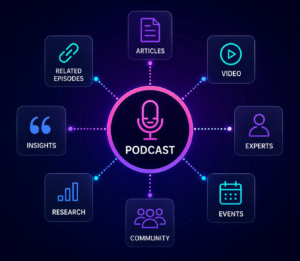
At JAR we believe a podcast can earn intimate attention. A live event can deepen that intimacy and give it a real community context. Video can extend the reach. Social can carry the sparks into new corners of the internet. Done properly, these pieces create a larger ecosystem of trust.
For a long time, selling this vision felt like an uphill battle against traditional agency logic. Much of the advertising playbook was still built around interruption: forcing a message in front of someone who was trying to read, watch, listen to, or do something else.
We bet on a different premise.
We believed a brand’s media budget could be used to create actual cultural value: shows, stories, conversations, and experiences compelling enough that an audience would actively choose to spend time with them. The work had to be useful, interesting, moving, funny, generous, genuinely entertaining, or real enough to bring people into the room.
Now, the industry is truly beginning to recognize the wisdom in that approach.
Most brands now understand that audiences have endless ways to skip, block, mute, scroll past, and ignore advertising that does not respect their time. The world is drowning in content. AI will only make that flood faster, slicker, and harder to trust.
The way forward is simple: make something that builds community and earns people’s time.
That is the duty now, same as it ever was: entertain, inform, move, delight, help, provoke, gather, or otherwise earn your place in someone’s day.
Suffice to say, at JAR, we are not scrambling to reinvent ourselves for this “new” era of brand-led content, creator-executives, or IRL resurgence.
That’s because we have spent nearly a decade helping C-suite executives show up as real people, and helping organizations think like media companies: creating popular shows and experiences that come from deep within the brand ecosystem while still serving the audience first.
So while the ad world rushes to update the language, we will keep doing the thing itself: making smart, strategic, human-led podcasts, video series, and live experiences that earn attention instead of interrupting it.
The language may be catching up. The work has been here all along.