

Beyond the weekly show: Here’s how content repurposing can unleash your podcast’s potential
Are you treating your podcast as just a weekly show? If so, you’re leaving a mountain of value on the table. Here’s a stat to chew on: 60% of marketers say repurposing content is more cost-effective than creating new material from scratch, yet most brands still treat their podcast like a one-and-done audio file.
Let’s get real. A podcast episode isn’t just a piece of audio — it’s a multi-format asset, a launchpad for a weekly content system that can fuel your entire marketing engine. At JAR Audio, we don’t just make podcasts. We build content ecosystems designed for maximum impact. (If you missed last week’s article on full-funnel distribution, go read it. Then come back. I’ll wait.)
The philosophy shift: From “weekly show” to “weekly content system”
The fallacy of format-bound thinking
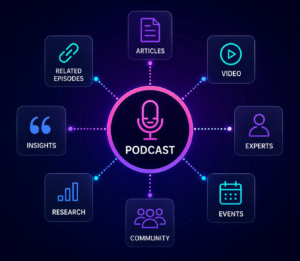
Let’s kill the myth: Podcasts are not just audio. If you’re only thinking in terms of “audio file goes on Spotify,” you’re playing checkers while your competitors are playing 4D chess. A podcast is a container for ideas, not just a medium. That’s why JAR produces both audio and video podcasts — so your content can live (and thrive) on every platform your audience touches. Still stuck in audio-only land? Check out our previous deep-dive on video podcasting.
Reach vs. value: Beyond the Spotify Charts
If you’re measuring podcast success by downloads alone, you’re missing the forest for the trees. Podcasting creates intent-rich engagement that often shows up off-platform — brand lift, sales conversations, internal buy-in. One episode can drive brand consideration (like we did with AMEX) and stakeholder engagement (see Genome BC) at the same time. That’s the power of multi-purpose content.
The invisible influence of brand storytelling in the AI age
Here’s the dirty secret: In the age of AI search, brand positioning is more important than ever. Branded podcasts shape perception, trust, and awareness in ways that don’t always show up in your analytics dashboard. Perfect attribution? Good luck. The real win is business impact—something JAR Audio obsesses over. Zero fluff. All outcomes. (Want more on this? Read our take on content attribution and ROI.)
Linear thinking vs. content ecosystems: A new model
Still following the old “record → publish → promote” playbook? That’s as outdated as dial-up. The new model is nonlinear — your podcast is the catalyst for a multi-format, multi-touchpoint brand narrative. And don’t forget to refresh and update your repurposed content. If your “greatest hits” are gathering dust, you’re wasting assets.
Breaking down silos: Production and performance as a unified force
Here’s a classic blunder: The content team makes the podcast, the marketing team promotes it, and never the twain shall meet. Treat your podcast as a full-stack content engine and watch those silos crumble. Better collaboration, better results. CMOs, comms leads, brand teams — if you’re struggling to prove ROI or cut through internal noise, JAR Audio is your secret weapon.
The myth of dilution: Amplifying meaning through thoughtful multiplication
Worried that repurposing will water down your message? Nonsense. Thoughtful multiplication amplifies meaning. If you do it right, every new format deepens the story — not dilutes it.
Practical strategies for multiplying podcast impact
Content repurposing methods
- Blog posts: Use tools like Descript or Designrr to turn episodes into SEO-rich articles.
- Visuals: Create graphics, infographics, and animated snippets with Canva or Adobe Spark.
- Video content: Record sessions, edit highlight reels, or host live Q&As. Opus Clip is a killer for short-form video.
- Newsletters: Recap episodes, share exclusive content, or tease upcoming guests.
- Social media: Tailor snippets for X, Instagram, Facebook, LinkedIn, TikTok. Each platform has its own “currency” — don’t post and pray.
- Online courses: Package educational content into structured learning on Teachable or Udemy.
- Guides/Ebooks: Bundle insights into lead magnets.
- Live Events/Webinars: Host Q&As, invite guests, or run workshops.
- Mobile apps: Offer easy playback, show notes, and exclusive content.
- Physical products: Books, merch, games, planners — if it fits your brand, go for it.
Monetization strategies
- Gated content: Offer premium assets behind a paywall.
- Sponsorships: Attract sponsors for repurposed assets (not just the main show).
- Affiliate links: Integrate relevant offers into blog posts, newsletters, or videos.
- Courses & workshops: Charge for in-depth learning experiences.
Tools and technologies
Here’s a breakdown of the top tools for repurposing in 2025:
| Tool | Audio Editing | Video Editing | Transcription | Social Clips | Blog/Newsletter | AI-Powered | Pricing (USD/mo) |
| Descript | Yes | Yes | Yes | Yes | Yes | Yes | $12–$24+ |
| Recast | No | Yes | Yes | Yes | Yes | Yes | $29–$59+ |
| Castmagic | No | No | Yes | Yes | Yes | Yes | $39–$299 |
| Podium | No | No | Yes | Yes | Yes | Yes | $16–$99 |
| Opus Clip | No | Yes | No | Yes | No | Yes | $19–$49 |
| Canva | No | Yes | No | Yes | No | No | $0–$12.99 |
| Headliner | No | Yes | No | Yes | No | Partial | $0–$19.99 |
Pro tip: If you want one tool to rule them all, Descript is your best bet. For speed, Recast Studio and Castmagic are standouts. Video-first? Opus Clip. Want more? See the full comparison here.
Legal and ethical considerations
Don’t get cocky — copyright is real, and “fair use” is not a get-out-of-jail-free card. Here’s what you need to know:
- Copyright: If you don’t own it, don’t repurpose it. Get written permission for third-party content, music, or guest clips.
- Fair Use: Commercial podcasts rarely qualify. Don’t risk it unless you’ve got a lawyer on speed dial.
- Permissions: Use release forms for guests and collaborators. Spell out rights for user-generated content.
- Ethics: Don’t misrepresent, take out of context, or violate privacy. Always credit original creators.
- International: Copyright laws vary. If you’re global, do your homework.
Still think you can wing it? Prove it — just don’t call me when the cease-and-desist lands. More legal tips here.
Accessibility
If your content isn’t accessible, you’re leaving out a massive chunk of your audience (and opening yourself up to legal headaches).
- Captions: Every video needs accurate captions. Use AI tools, but always review for accuracy.
- Alt text: Every image and graphic should have descriptive alt text.
- Transcripts: Provide full transcripts for audio and video content.
- Contrast & readability: Use high-contrast colors and readable fonts.
- Accessible platforms: Make sure your website and app meet WCAG standards.
Accessibility isn’t a “nice to have” — it’s table stakes.
Analytics and measurement
If you’re not tracking, you’re guessing. Here’s what actually matters:
- Reach & impressions: Per channel, per asset.
- Engagement: Likes, shares, comments, CTR, watch time.
- Traffic & referrals: UTM-tagged links, bounce rate, time on page.
- Conversions: Email signups, downloads, demo requests.
- Audience Growth: Podcast subscribers, newsletter signups, social followers.
- Brand lift & sentiment: Mentions, sentiment analysis, qualitative feedback.
- Platform-specific metrics: Tailor to each channel’s strengths.
Double down on what works, kill what doesn’t, and let the data drive your next move. More on podcast analytics here.
Content repurposing: Keep your greatest hits working
Don’t let your best work rot in the archives. Here’s how to keep it sharp:
- Audit regularly: Identify high-performing or evergreen content that’s lost its edge.
- Update data: Refresh stats, links, and visuals.
- Expand & refine: Fill gaps, add new insights, improve structure.
- Repurpose again: Turn old hits into new formats — videos, infographics, guides.
- SEO tune-up: Update keywords, meta tags, and submit for reindexing.
- Promote like new: Announce updates, use “Updated for 2025” tags, and hit new channels.
- Set a cadence: Review and refresh quarterly or annually.
If you’re not refreshing, you’re leaving money (and audience trust) on the table.
Conclusion: Unlock your podcast’s true potential with a strategic approach to content repurposing
Let’s recap: Shifting from a “weekly show” mentality to a “weekly content system” is the difference between being just another voice in the void and building a content powerhouse. Multi-format thinking, brand storytelling, and ruthless repurposing aren’t just buzzwords — they’re the backbone of modern podcast strategy.
At JAR, we don’t just make podcasts. We build content engines that drive real business outcomes. If you’re ready to start treating every episode as a multi-format asset — and if you want a partner who’s obsessed with ROI, storytelling, and making your brand impossible to ignore — let’s talk.
Final thought: The future of podcasting isn’t about who shouts the loudest. It’s about who tells the most compelling story, in the most places, for the people who actually care. Are you ready to make your content work harder? Or are you still counting downloads like it’s 2012?